
You’ll want Diamond Crystal if purity matters, as it’s 99.6% sodium chloride with minimal additives. It dissolves faster and reduces maintenance compared to Morton’s 99% purity with fillers.
Diamond Crystal’s varied grain sizes also promote consistent flow and less bridging. While Morton may be easier to find and offers better packaging, it dissolves slower and can cause more resin sludge.
Choosing the right salt affects your system’s efficiency and longevity. Explore how salt forms and maintenance play essential roles next.
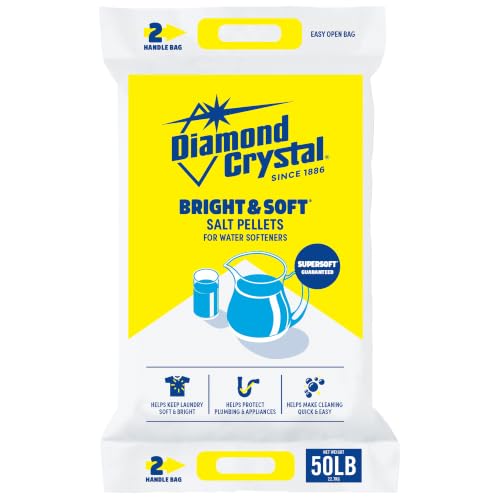
- Effective Water Softening Solution: Bright & Soft Salt Pellets transform hard water into soft water…
- Premium Purity Formula: Made with typically 99.8% pure salt and greater than 99.7% water soluble…
- Everyday Household Benefits: Soft, bright laundry and hair, plus spot-free dishes, make these…
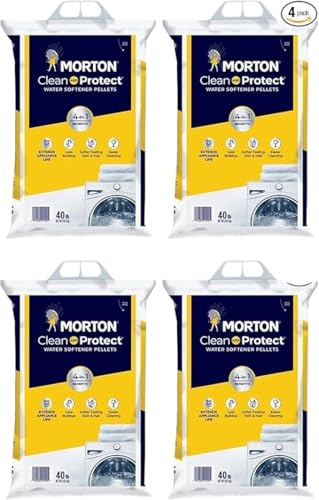
- 4 Bags of Clean and Protect, 160lbs total. Enhanced Cleaning Benefits: Softer water makes…
Key Takeaways
- Diamond Crystal salt has higher purity (99.6%) compared to Morton’s 99%, enhancing faster dissolution and better ion exchange efficiency.
- Diamond Crystal offers 11 salt forms with uniform grain sizes, reducing bridging and sludge, while Morton mainly provides pellets and crystals.
- Diamond Crystal dissolves quickly without residues, minimizing brine tank maintenance, whereas Morton’s additives can cause bridging and more frequent cleaning.
- Diamond Crystal generally costs less but may be harder to find locally; Morton is widely available with superior packaging for easier handling.
- For iron removal and system longevity, Diamond Crystal’s high purity better preserves resin stability and reduces maintenance frequency compared to Morton.
Diamond Crystal Vs Morton Softener Salt Comparison
| Comparison Factor | Diamond Crystal Softener Salt | Morton Softener Salt |
|---|---|---|
| Sodium chloride purity | Approximately 99.6% purity with minimal additives | Approximately 99% purity, depending on the product |
| Dissolving performance | Generally dissolves quickly and produces consistent brine | Dissolves effectively but may be slightly slower in some systems |
| Salt forms available | Offers pellets, crystals, rocks, coarse grains, and fine grains | Primarily available as pellets and crystals |
| Bridging and mushing risk | Uniform grains may help reduce bridging and salt buildup | Uneven dissolution may create a higher buildup risk in some tanks |
| Residue and sludge | Higher purity may leave less insoluble residue and sludge | Some formulations may produce more residue over time |
| System maintenance | May support less frequent brine tank cleaning | Could require more regular tank inspection and cleaning |
| Iron-related performance | High-purity options may help limit resin fouling in iron-rich water | Suitable for moderate conditions, especially when using an iron-fighting formula |
| Product availability | Availability may be limited in certain locations | Usually widely available in stores and online |
| Packaging and handling | Packaging quality varies by product and retailer | Often recognised for convenient, durable packaging |
| Best suited for | Users prioritising purity, cleaner dissolution, and lower residue | Users prioritising availability, convenience, and product familiarity |
Purity Levels Compared: Diamond Crystal vs Morton Salt

When comparing purity levels, you’ll find that Diamond Crystal salt contains 99.6% sodium chloride with minimal additives.
Morton averages about 99% purity and includes some filler materials.
Morton salt averages 99% purity but contains filler materials that may affect performance.
This higher purity in Diamond Crystal guarantees faster dissolution rates and reduces resin sludge buildup in your water softener.
Additives in Morton‘s formulation can contribute to bridging and mushing within brine tanks, potentially impairing softener performance.
Both brands provide high-purity salt options, but Diamond Crystal consistently maintains a superior sodium chloride margin, enhancing efficiency.
Choosing salt with fewer impurities directly affects the longevity and maintenance needs of your system by minimizing insoluble residues.
Thus, if you prioritize peak softening function and reduced maintenance, Diamond Crystal’s higher purity salt offers a technical advantage over Morton’s standard formulations.
Additionally, using salts with gentle mineral reduction properties can help reduce skin dryness and irritation caused by hard water.
Water Softener Salt Forms and Grain Sizes Explained
Beyond purity levels, the physical form and grain size of water softener salt markedly influence its performance in your system.
Diamond Crystal offers 11 product forms, including pellets, rocks, and crystals, allowing you to select based on your softener’s requirements.
Morton focuses primarily on pellets and crystals, with fewer options.
Pellet forms from both brands guarantee even distribution within the resin tank, reducing bridging risks.
Regarding grain size, Diamond Crystal provides coarse, fine, and uniformly sized crystals, promoting consistent flow and efficient brine saturation.
Morton offers coarse and fine grains but may experience higher bridging tendencies due to uneven grain distribution.
Uniform grain size optimizes salt flow and prevents blockages, maintaining system efficiency.
Choosing the appropriate form and grain size directly impacts your softener’s operational reliability and longevity.
Selecting salt that complements your water softener’s control valve can maximize system efficiency and performance.
How Dissolving Speed Impacts Softener Performance?
Although dissolving speed might seem like a minor factor, it markedly affects your water softener’s efficiency and lifespan. When salt dissolves rapidly, it creates a concentrated brine solution quickly, essential for effective ion exchange in the resin bed.
Rapid salt dissolving boosts water softener efficiency and extends its lifespan through effective brine creation.
Diamond Crystal’s high-purity salt dissolves swiftly without leaving insoluble residues, minimizing sludge buildup. This reduces bridging and mushing in the brine tank, guaranteeing consistent regeneration cycles and prolonging system life.
Morton’s salt also dissolves evenly, suitable for typical residential use, but may contain more fillers that slow saturation slightly. If your salt dissolves slowly, the brine concentration weakens, leading to incomplete regeneration and harder water.
Choosing a salt with peak dissolving speed, like Diamond Crystal or Morton, guarantees reliable softening performance and lowers maintenance frequency. Using high-purity salt enhances ion exchange efficiency and reduces residue buildup, further improving system function.
Price and Availability of Diamond Crystal and Morton Salt
Salt choice impacts not only your softener’s efficiency but also your budget and shopping convenience.
Diamond Crystal salt is generally less expensive than Morton, despite its higher purity level.
You’ll find Morton salt more readily available in hardware stores, grocery outlets, and online retailers, benefiting from superior packaging that eases transport and handling.
On the other hand, Diamond Crystal products may require more effort to locate in certain regional markets, though they offer competitive pricing and excellent value for quality.
Both brands maintain competitive price points, but your choice may hinge on local availability and packaging preferences.
When selecting salt, balancing cost with accessibility guarantees uninterrupted softener operation without compromising on purity or performance.
Choosing salt types compatible with septic system health can help protect your system from damage and maintain long-term functionality.
Best Salt for Iron Removal and System Maintenance
When dealing with water that contains high iron levels, choosing the right softener salt is essential to maintaining system efficiency and longevity. Diamond Crystal’s high-purity salt minimizes resin fouling and reduces sludge buildup, making it ideal for iron removal.
Morton salt performs well in moderate conditions but may require more frequent brine tank maintenance. Both salts prevent costly system issues when selected properly.
Using high-purity salt helps preserve the chemical stability of water softener resins, extending their effective lifespan.
| Feature | Diamond Crystal | Morton |
|---|---|---|
| Iron Removal Efficiency | Superior due to 99.6% purity | Effective, ~99% purity |
| Resin Maintenance | Less resin gumming and sludge | Moderate resin buildup |
| Brine Tank Cleaning | Every 3–6 months recommended | More frequent cleaning needed |
| System Longevity | Extended lifespan with proper use | Standard lifespan |
Frequently Asked Questions
Can Diamond Crystal or Morton Salt Be Used in Commercial Water Softeners?
Yes, you can use both Diamond Crystal and Morton salt in commercial water softeners.
You’ll want to select high-purity pellets or crystals to guarantee efficient dissolution and minimize resin fouling.
Diamond Crystal’s higher purity and uniform grain size often improve performance in heavy-demand systems.
Morton’s salts are suitable for typical commercial setups.
Always match the salt type to your system’s specifications to optimize softening efficiency and reduce maintenance frequency.
Are There Environmentally Friendly Disposal Methods for Used Water Softener Salt?
Yes, you can dispose of used water softener salt responsibly by recycling brine sludge at authorized facilities.
You can also use it in controlled agricultural applications where sodium levels won’t harm soil.
Avoid dumping it into storm drains or natural waterways, as high salinity damages ecosystems.
Consider contacting local waste management services for guidelines on salt waste disposal to guarantee environmental compliance and prevent contamination.
How Do Storage Conditions Affect the Quality of Softener Salt Over Time?
You should know that softener salt with over 1% moisture can clump and lose effectiveness.
Storing salt in a cool, dry place prevents moisture absorption, preserving purity and flowability.
Avoid exposure to humidity and temperature fluctuations, which accelerate caking and bridging inside your brine tank.
Using airtight, moisture-resistant containers helps maintain peak grain size and dissolving speed. This ensures your water softener performs efficiently and reduces maintenance frequency over time.
Can Water Softener Salt Impact the Taste of Drinking Water?
Yes, water softener salt can impact your drinking water’s taste. If the salt contains impurities or additives, it may leave a slight salty or chemical flavor.
High-purity salts dissolve cleanly, minimizing taste alterations. Improper softener regeneration or excess salt in the brine can cause noticeable taste changes.
To keep your water tasting natural, use high-quality salt and maintain your system properly. Avoid salt bridging or mush buildup.
Are There Health Risks Associated With Handling or Inhaling Softener Salt Dust?
Yes, inhaling softener salt dust can irritate your respiratory system, especially since fine salt particles can penetrate deep into your lungs.
Studies show that exposure to salt dust increases the risk of coughing, sneezing, and throat irritation.
When handling salt, you should wear protective gloves and a mask to avoid skin dryness and inhalation.
Always work in a well-ventilated area to minimize airborne dust and reduce health risks effectively.
Diamond Crystal vs Morton Softener Salt: Final Verdict
When choosing between Diamond Crystal and Morton softener salt, you weigh purity against dissolution speed, grain size against system compatibility, cost against availability, and iron removal efficiency against maintenance needs.
You want salt that melts smoothly, protects your system consistently, and fits your budget reliably.
By comparing these factors side by side, you guarantee your water softener performs at its best, lasts longer, and keeps your water crystal clear every time you use it.

- NEW LOOK – SAME GREAT SALT!
- No Additives & Less Sodium: The only pure kosher salt with 53% less sodium by volume compared to…
- Light Texture: Renowned for its distinctly coarse yet fragile texture, our hollow kosher salt flakes…

- Morton Clean and Protect Water Softener Salt Pellets, 25 LB Bag LuxeLeaf (Pack (1)
Last update on 2026-10-22 / Affiliate links / Images from Amazon Product Advertising API