Last Updated on September 2, 2026
You’ll choose pipe bursting if your pipe is severely damaged, collapsed, or undersized. It fully replaces and can upsize the pipe, boosting flow capacity.
Pipe lining suits pipes that hold shape but have cracks or leaks. It preserves the existing pipe with minimal disruption.
Bursting requires excavation for access pits and costs more upfront but offers longer durability. Lining costs less and limits downtime but slightly reduces diameter.
Explore the details to find the best solution for your project goals.
Key Takeaways
- Pipe bursting fully replaces damaged pipes by fracturing old pipe and inserting a new larger HDPE pipe, improving flow capacity and durability.
- Pipe lining inserts an epoxy-saturated liner inside an existing pipe, sealing cracks but slightly reducing diameter and relying on pipe structural soundness.
- Pipe bursting suits collapsed or crushed pipes needing upsizing, while pipe lining is ideal for pipes with cracks or leaks but intact structure.
- Pipe bursting requires two access pits and is slightly more invasive, whereas pipe lining uses minimal access points like cleanouts, causing less surface disruption.
- Pipe bursting costs $60–$200 per foot with 50–100+ years lifespan; pipe lining costs $80–$250 per foot with a 50–60 years lifespan.
Pipe Bursting vs Pipe Lining Comparison: Cost, Disruption, Lifespan, and Best Use
| Comparison Point | Pipe Bursting | Pipe Lining | Best Choice |
|---|---|---|---|
| Main Method | Breaks the old pipe apart and pulls in a new HDPE pipe | Inserts an epoxy-saturated liner inside the existing pipe | Depends on pipe condition |
| Best For | Collapsed, crushed, severely damaged, or undersized pipes | Pipes with cracks, leaks, or root intrusion but intact shape | Bursting for severe damage |
| Pipe Replacement | Provides a complete pipe replacement | Rehabilitates the existing pipe from the inside | Bursting for a new pipe |
| Structural Requirement | Does not rely on the old pipe’s condition | Needs a structurally sound host pipe | Lining only if pipe is stable |
| Flow Capacity | Can increase pipe diameter and improve flow | Slightly reduces inner diameter due to liner thickness | Bursting for more flow |
| Access Needed | Usually requires two access pits | Often uses cleanouts or minimal entry points | Lining for less access work |
| Surface Disruption | More invasive than lining but still trenchless | Causes minimal surface disruption | Lining for low disruption |
| Typical Lifespan | Around 50–100+ years with new HDPE pipe | Around 50–60 years with cured-in-place liner | Bursting for longer durability |
| Cost Range | Often around $60–$200 per foot | Often around $80–$250 per foot | Varies by project scope |
| Best Overall Use | Major pipe failure, upsizing, and long-term replacement | Lower-disruption repair for stable leaking pipes | Match to damage and goals |
How Pipe Bursting Works?
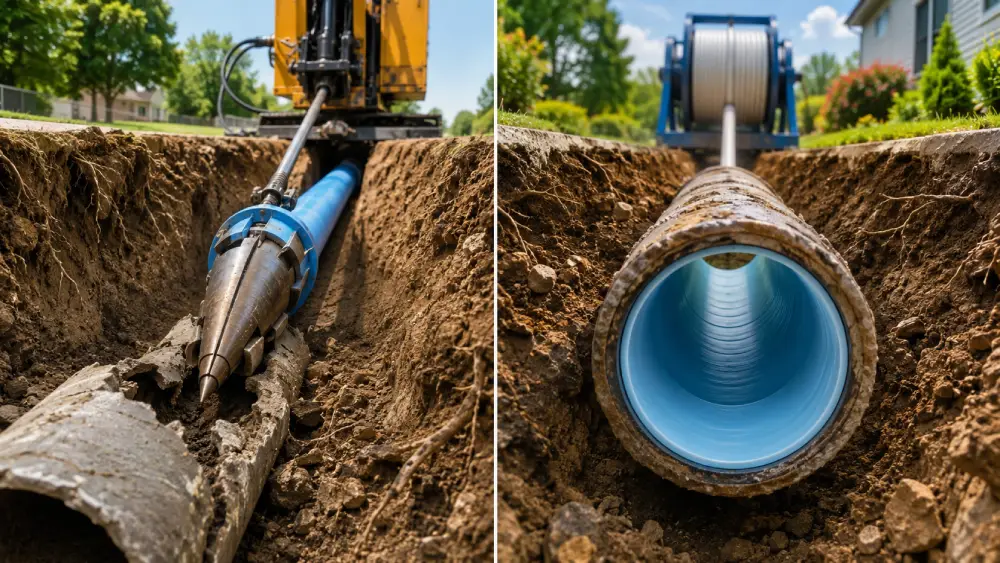
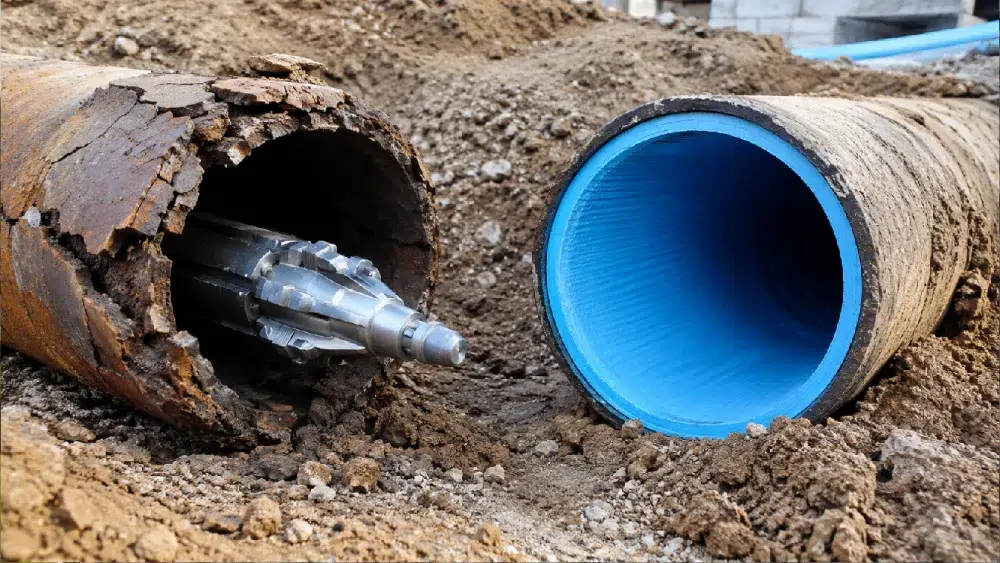
Pipe bursting works by fracturing the existing underground pipe with a bursting head, which simultaneously pulls a new pipe, usually made of HDPE, into the vacated space.
You’ll position the bursting head at the entrance pit, then use hydraulic or pneumatic power to drive it through the old pipe.
As it moves forward, the head breaks apart the old pipe, pushing fragments into the surrounding soil.
Behind the head, the new pipe follows, occupying the exact path cleared by the burst pipe.
This method allows you to completely replace pipes that are collapsed, crushed, or undersized.
Since the old pipe is destroyed, you don’t need to worry about its condition, making pipe bursting a suitable solution for severe structural failures without extensive excavation.
Regular inspection and maintenance are important to avoid issues like clogged discharge pipes that can affect underground piping systems.
How Pipe Lining Works?
To kick off pipe lining, you begin by inserting a flexible liner that’s soaked in epoxy resin into the existing pipe. Once it’s in place, the resin cures, creating a seamless new interior.
Pretty neat, right? This whole cured-in-place process uses materials like felt or fiberglass, which help form a strong, corrosion-resistant barrier.
Now, it’s important to understand these materials and how the curing method works. This knowledge really helps in appreciating the structural benefits of pipe lining.
This trenchless method also eliminates excavation, minimizing disruption to your property and reducing labor costs.
Cured-In-Place Process
Understanding the cured-in-place process starts with recognizing how a flexible liner saturated with epoxy resin is inserted into the existing pipeline.
You’ll typically invert or pull the liner into place using water or air pressure, ensuring full contact with the pipe’s interior.
Once positioned, you cure the resin by applying heat, steam, or UV light, triggering a chemical reaction that hardens the liner.
This creates a rigid, seamless pipe within the host pipe.
This method preserves the host pipe’s structural integrity while sealing cracks and leaks.
The cured liner effectively forms a new pipe layer, slightly reducing the diameter but restoring hydraulic capacity and preventing infiltration.
Because the host pipe remains in place, the process requires careful inspection beforehand to confirm it can support the new liner.
Using a sewer camera inspection ensures the existing pipe condition is thoroughly evaluated before lining.
Liner Materials Used
Although the liner materials vary, the most common types used in trenchless pipe lining are epoxy-saturated felt and fiberglass.
These materials form the structural basis of the cured-in-place pipe (CIPP) that rehabilitates the existing line.
You’ll find that each material offers specific benefits depending on pipe conditions and project requirements.
- Epoxy-Saturated Felt: Flexible and conforms easily to pipe bends, providing excellent adhesion and corrosion resistance.
- Fiberglass: Offers superior tensile strength and durability, ideal for pipes requiring enhanced structural reinforcement.
- Resin Systems: Typically epoxy or polyester resins impregnate the liner, curing in place to create a rigid, seamless pipe within the host pipe.
Selecting the appropriate liner material guarantees peak lifespan and structural integrity while minimizing diameter reduction inside the pipeline. Additionally, using materials compatible with multiple pipe materials ensures versatility and long-term performance in various pipe rehabilitation projects.
Choosing Between Pipe Bursting and Pipe Lining: When to Use Each
When deciding between pipe bursting and pipe lining, you need to assess the existing pipe’s condition and the project goals carefully.
Use pipe bursting if the pipe is collapsed, crushed, or undersized, or if upsizing is needed. Opt for pipe lining when the pipe holds its shape but has cracks, leaks, or root intrusion.
Consider site access, desired flow capacity, and structural requirements.
| Condition | Pipe Bursting | Pipe Lining |
|---|---|---|
| Pipe Shape | Severely damaged or collapsed | Structurally sound but leaking |
| Flow Capacity | Can increase pipe diameter | Slightly reduces inner diameter |
| Installation Access | Two small pits required | Uses existing cleanouts or minimal access |
Choose based on pipe integrity and project scope for best results. It is also important to consider how water chemistry can impact long-term pipe integrity and the risk of leaks.
Comparing Costs of Pipe Bursting vs Pipe Lining
Comparing the costs of pipe bursting and pipe lining requires analyzing multiple factors such as pipe length, diameter, soil conditions, and access complexity.
You’ll find pipe bursting generally ranges from $60 to $200 per linear foot, while pipe lining spans $80 to $250 per linear foot.
Despite pipe lining often having a lower upfront cost, pipe bursting replaces the pipe entirely, affecting the overall price.
Consider these key cost influencers:
- Project Scope: Pipe bursting suits severe pipe damage, often costing more due to full replacement.
- Installation Access: Pipe lining uses existing cleanouts, reducing labor and excavation costs.
- Material and Pipe Size: Larger diameters increase costs for both, but pipe bursting can upsized pipes, influencing price.
Additionally, selecting materials with proper diameter and wall thickness is crucial to ensure long-term durability and prevent clogging or collapse, which can impact maintenance costs.
Lifespan and Durability: Which Lasts Longer?
Since long-term performance is critical for trenchless pipe repairs, understanding the lifespan and durability differences between pipe bursting and pipe lining helps you make an informed choice.
Pipe bursting delivers a brand-new HDPE pipe with an expected service life of 50 to 100+ years, providing maximum structural integrity and resilience.
In contrast, pipe lining rehabilitates the existing host pipe by applying a cured-in-place epoxy liner, typically lasting 50 to 60 years.
While both methods offer durable solutions, pipe bursting’s full replacement guarantees no dependency on the original pipe’s condition, making it more reliable for severely damaged lines.
Pipe lining extends pipe life effectively but relies on the host pipe’s structural soundness.
Your decision should weigh these longevity factors against specific pipeline conditions to optimize durability outcomes.
It is important to consider that systems relying on natural structural integrity often offer greater reliability over those depending on existing conditions.
Installation Process and Disruption for Both Methods
Understanding the lifespan and durability differences sets the stage for evaluating how pipe bursting and pipe lining impact installation logistics and site disruption. When you consider both methods, you’ll notice distinct operational footprints.
- Pipe bursting requires two small access pits: entry and exit. This allows for the old pipe’s destruction and replacement with a new HDPE pipe, typically completed within one to two days.
- Pipe lining uses existing cleanouts or minimal access points. It installs an epoxy-saturated liner inside the host pipe and takes about one to three days, depending on pipe condition.
- Both methods markedly reduce surface excavation compared to traditional open-trench repairs. This minimizes disruption while offering trenchless solutions.
You’ll find pipe bursting slightly more invasive due to excavation needs but faster overall. Pipe lining offers less disruption with potentially longer installation times. Additionally, considering the flow rate and operating pressure differences is important when selecting the appropriate trenchless pipe repair method.
How Pipe Bursting Can Increase Pipe Size?
Pipe bursting allows you to replace an existing pipeline with a larger diameter pipe, effectively increasing flow capacity without additional excavation.
The process involves fracturing and displacing the old pipe outward while simultaneously pulling a new, larger-diameter pipe into the void.
This method lets you upsize the pipeline beyond the original pipe’s dimensions, which directly enhances hydraulic performance and reduces bottlenecks.
Since you destroy the old pipe, you’re not limited by the previous pipe’s size or condition, unlike pipe lining that inserts a liner reducing diameter slightly.
With pipe bursting, you can select a new HDPE pipe with a greater cross-sectional area, optimizing flow rates for increased demand or future capacity needs.
This upsizing capability offers a strategic advantage in infrastructure upgrades without costly surface disruption.
Additionally, pipe bursting provides a permanent pipe repair solution that seals cracks and joints to prevent root intrusion and ensure long-term pipeline integrity.
Advantages and Limitations of Pipe Bursting and Pipe Lining
Increasing pipe size through bursting offers clear performance benefits. However, it’s important to weigh the specific advantages and limitations of both pipe bursting and pipe lining for your project.
Pipe bursting fully replaces the pipe, providing a new HDPE pipe with up to 100 years of durability. It requires two access pits and has a higher cost. Pipe lining rehabilitates the existing pipe, minimizing access needs and often reducing downtime. However, it slightly decreases diameter and depends on a structurally sound host pipe.
Consider these key points:
- Pipe bursting excels in severely damaged or undersized pipes but involves more invasive installation.
- Pipe lining suits pipes with cracks or leaks but can’t fix collapsed pipes.
- Cost and lifespan vary; bursting often costs more upfront but offers longer durability.
Choose based on pipe condition and performance needs. Additionally, pipe relining is a trenchless solution that restores structural integrity without full excavation, making it less disruptive.
Key Tradeoffs When Choosing Pipe Bursting or Pipe Lining
When you’re deciding between pipe bursting and pipe lining, it’s important to think about the structural integrity of your existing pipe. You want to make sure that whatever option you choose will last.
So, here’s the scoop: pipe bursting actually replaces the old pipe entirely. That means you’re getting a brand-new, durable line.
On the flip side, pipe lining just reinforces the current pipe. However, its effectiveness really depends on how sound that existing pipe is.
And let’s not forget about costs. You’ll want to balance the initial expenses with how the repair will perform over time.
Pipe bursting can be a bit pricier upfront, but it might save you money in the long run thanks to its greater longevity. It’s all about weighing your options!
Structural Integrity Considerations
Although both pipe bursting and pipe lining offer trenchless solutions, you must carefully evaluate the structural integrity of the existing pipeline before selecting either method.
Pipe bursting completely replaces the old pipe, providing you with a new HDPE pipe that guarantees structural soundness regardless of the host pipe’s condition. In contrast, pipe lining relies on the host pipe’s existing structure to support the cured-in-place liner, making it unsuitable if the pipe is severely damaged.
Consider these key points:
- Pipe bursting eliminates compromised pipes, ideal for collapsed or crushed lines.
- Pipe lining reinforces but depends on a structurally stable host pipe.
- Pipe bursting can increase pipe diameter, improving flow and durability beyond original specs.
Your choice hinges on evaluating whether the existing pipe can structurally support a liner or requires full replacement.
Cost Versus Longevity
Evaluating the structural integrity of your pipeline guides your choice between pipe bursting and pipe lining. However, cost and longevity often determine the final decision.
Pipe bursting generally entails higher upfront costs, ranging from $60 to $200 per linear foot. It delivers a completely new HDPE pipe with a lifespan up to 100 years.
Conversely, pipe lining costs typically fall between $80 and $250 per linear foot, which is slightly less upfront. This method offers a cured-in-place liner that extends the existing pipe’s life by roughly 50 to 60 years.
You’ll want pipe bursting if you prioritize long-term durability and full replacement despite higher costs. Choose pipe lining to reduce initial expenses when the host pipe remains structurally sound, accepting a moderately shorter lifespan.
Both offer trenchless solutions, but your budget and expected service life will drive the best choice.
Making the Right Choice for Your Pipe Repair Project
Deciding between pipe bursting and pipe lining hinges on evaluating your pipe’s current condition and project goals.
You need to analyze the structural integrity of your existing pipe and the extent of damage before choosing a method.
Consider these factors:
- Pipe Condition: Choose pipe bursting if the pipe is collapsed or severely damaged. Opt for lining if the pipe is structurally sound but has leaks or cracks.
- Flow Capacity Requirements: Use pipe bursting to upsize pipes and increase flow. Lining slightly reduces diameter and maintains current capacity.
- Budget and Disruption: Lining generally costs less upfront and causes minimal disruption. Bursting requires more access but offers a complete replacement.
This analytical approach guarantees you select the best repair method tailored to your project’s technical and financial constraints.
Frequently Asked Questions
Are There Environmental Impacts From Pipe Bursting or Pipe Lining Methods?
Yes, both methods have environmental impacts you should consider.
Pipe bursting disturbs soil more due to fracturing and removal of the old pipe, potentially affecting underground ecosystems.
It also requires disposing of pipe debris.
Pipe lining minimizes excavation and waste by rehabilitating the existing pipe, reducing soil disruption and landfill needs.
However, it involves chemicals like epoxy, which you must handle carefully to avoid environmental contamination during installation and curing.
How Do Weather Conditions Affect Pipe Bursting and Pipe Lining Projects?
Weather conditions can make your pipe repair project either smooth sailing or a stormy challenge.
Heavy rain or frozen ground can delay pipe bursting by making access pits unstable and soil harder to work with.
Pipe lining is somewhat more resilient but still suffers if water infiltrates the liner during curing, risking weak bonds.
You’ll want to schedule during mild, dry periods to guarantee proper installation and avoid costly setbacks.
Can Pipe Bursting or Lining Be Used for Pipes With Hazardous Materials?
You can use pipe bursting or lining for pipes carrying hazardous materials, but you must follow strict safety protocols.
Pipe bursting fully replaces the pipe, which is beneficial if contamination risks exist.
Pipe lining rehabilitates the existing pipe without removal.
Handling hazardous material pipes requires specialized containment, ventilation, and disposal measures during installation.
Always consult environmental and safety regulations to guarantee compliance and protect workers and the environment throughout the process.
Is Special Maintenance Required After Pipe Bursting or Pipe Lining Installation?
You’d expect a brand-new pipe to need daily pampering, right?
Actually, after pipe bursting or lining, maintenance is minimal. Both methods create durable, long-lasting pipelines often rated for 50+ years.
You’ll want routine inspections and perhaps occasional cleaning to prevent buildup, but there’s no special upkeep beyond standard pipeline care.
The main goal is ensuring the system remains clear and functional. No miracle treatments are required post-installation.
Are There Size Limitations for Pipes That Can Be Repaired With These Methods?
You can repair a wide range of pipe sizes with both methods, but each has limits.
Pipe bursting handles pipes roughly from 2 inches up to 36 inches in diameter and can upsized lines, making it flexible.
Pipe lining typically works best for pipes between 4 and 36 inches but slightly reduces diameter due to the liner thickness.
Going beyond these sizes may require specialized equipment or alternative techniques.
Final Verdict on Pipe Bursting vs Pipe Lining
You might think choosing between pipe bursting and pipe lining is as simple as picking your favorite tool, but it’s not. Each method has its quirks: bursting can enlarge pipes but is more invasive, while lining is less disruptive yet limited in size.
So, unless you enjoy unexpected surprises in cost, durability, or pipe size, you’ll want to analyze your project’s specifics carefully before deciding. After all, precision beats guesswork every time.