Last Updated on August 11, 2026
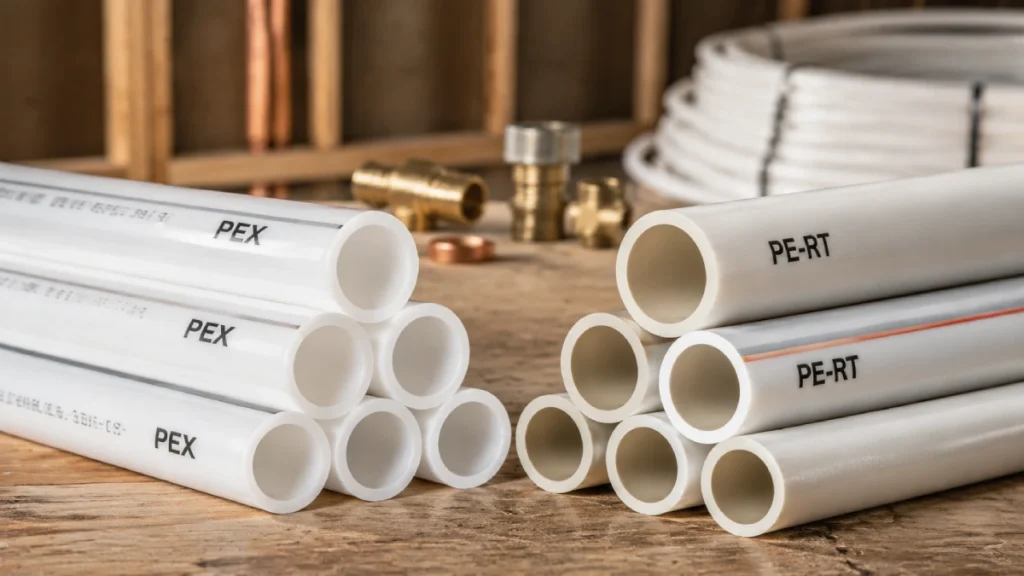
If you need flexible piping, PE RT uses non-cross-linked resin blends offering easier bending and about 20% lower cost than PEX.
PEX’s chemically cross-linked network provides superior thermal resistance up to 90°C and higher pressure capacity, around 100 psi continuous, thanks to its 3D covalent bonds.
PE RT suits applications under 82°C with simpler, mechanical fittings, while PEX demands specialized tools but delivers enhanced durability.
Exploring further reveals detailed performance, installation, and lifecycle differences between these materials.

- PE Material – The RO tubing is made of PE material and does not contain BPA, it have the advantages…
- STANDARD UNIVERSAL SIZE – Outside diameter of polyethylene tubing is 1/2 inch (12.7 mm), works with…
- EASY INSTALLATION – Aquarium tubing is flexible and easy to cut. Make sure to pick up an RO tubing…

- Superior PEX-B Pipe: Meticulously crafted from PE material, this 100FT long, 3/4inch diameter PEX-B…
- Cold-to-Hot Compatibility: With a wide temperature range of -40°C to 95°C (-40°F to 203°F), this…
- Outstanding Flexibility: PEX-B pipe boasts exceptional flexibility, even when bent into a circular…

Key Takeaways
- PE RT consists of linear polyethylene chains without cross-linking, while PEX is chemically cross-linked into a three-dimensional network.
- PEX offers higher thermal stability, supporting continuous use near 90°C (194°F), compared to PE RT’s limit around 82°C (180°F).
- PE RT is more flexible, easier to bend, and typically uses compression fittings without heat curing, unlike PEX’s specialized joining methods.
- PE RT has a higher recycling rate (~90%) and costs about 20% less than PEX, which faces recycling challenges due to cross-linking.
- PEX provides superior mechanical strength, durability (~95%), and pressure ratings compared to PE RT’s slightly lower durability and pressure capacity.
PE RT vs PEX Comparison: Flexibility, Heat Resistance, and Pipe Performance
| Comparison Point | PE RT | PEX | Best Choice |
|---|---|---|---|
| Molecular Structure | Uses linear polyethylene chains without cross-linking | Uses a chemically cross-linked 3D network | PEX for stronger structure |
| Flexibility | Offers easier bending and better movement in tight spaces | Flexible, but usually less bend-friendly than PE RT | PE RT for easy installation |
| Thermal Resistance | Best for applications under about 82°C | Handles higher heat, up to around 90°C | PEX for higher temperatures |
| Pressure Capacity | Suitable for moderate-pressure plumbing and heating systems | Offers stronger pressure capacity, around 100 psi continuous | PEX for pressure strength |
| Joining Method | Often uses simpler mechanical or compression fittings | May need crimp, expansion, push, or specialized fittings | PE RT for simpler joining |
| Installation Tools | Usually requires fewer specialized tools | Often needs specialized tools for proper connections | PE RT for tool simplicity |
| Durability | Durable for standard use, but lower under extreme heat stress | Stronger long-term durability due to cross-linking | PEX for long-term resilience |
| Cost | Usually about 20% lower cost than PEX | Higher cost due to extra processing and material structure | PE RT for budget value |
| Recyclability | Easier to recycle because it is non-cross-linked | Harder to recycle because of chemical cross-linking | PE RT for sustainability |
| Best Use Case | Flexible layouts, lower-temperature systems, cost-focused projects | Hot water, higher pressure, and durability-focused systems | Match to |
Molecular Differences of PE RT and PEX

Understanding the molecular differences between PE RT and PEX is essential for selecting the right material for your application.
PE RT is composed of linear polyethylene chains with a specific resin formulation that lacks chemical cross-linking. This results in a non-cross-linked molecular architecture.
In contrast, PEX undergoes a chemical cross-linking process, forming a three-dimensional network through covalent bonds between polymer chains. This cross-linked structure enhances PEX’s mechanical strength and thermal resistance.
PE RT’s linear chain configuration provides flexibility and ease of installation, while PEX’s network formation increases durability and pressure tolerance.
The manufacturing methods differ accordingly. PE RT utilizes high-performance resin blends without cross-linking, whereas PEX requires additional curing steps to establish permanent molecular bonds.
Your choice depends on balancing flexibility, strength, and thermal performance needs.
Additionally, considering the energy efficiency of the system in which these materials are used can impact overall performance and cost savings.
Cross-Linking Effects on PE RT and PEX Thermal Performance
Although both PE RT and PEX serve as durable piping materials, the presence or absence of chemical cross-linking materially impacts their thermal performance.
PEX’s chemically cross-linked molecular network creates permanent covalent bonds, markedly enhancing thermal stability. This allows continuous operation near 180°F with short spikes up to 200°F.
In contrast, PE RT remains a non-cross-linked material relying on enhanced resin formulations and physical chain arrangements. This limits its continuous temperature resistance to about 160°F.
You’ll find that PEX’s cross-linked framework also improves resistance to thermal degradation, maintaining material integrity under sustained heat exposure.
PE RT, while durable, exhibits lower bond stability without cross-linking. This makes it less resilient to prolonged thermal stress.
This fundamental molecular difference guides your selection when thermal endurance is critical in piping applications.
Additionally, PEX’s high cross-linking ratio also enhances its chemical resistance and flexibility, which contributes to its superior overall performance.
Thermal and Pressure Ratings Compared: PE RT vs PEX
When evaluating PE RT and PEX for thermal and pressure applications, you’ll notice distinct performance thresholds that influence material suitability.
PE RT typically sustains continuous operating temperatures around 82°C (180°F) with short-term peaks up to 110°C (230°F).
PE RT supports continuous use at 82°C, handling short-term temperature spikes up to 110°C.
In contrast, PEX withstands slightly higher continuous temperatures near 90°C (194°F) and peaks up to 110°C.
Regarding pressure ratings, PE RT maintains hydrostatic design stress around 80 psi continuous with burst pressures near 160 psi.
PEX generally offers superior pressure endurance, sustaining continuous loads up to 100 psi and bursts around 160 psi.
These differences arise from PEX’s chemically cross-linked network, enhancing thermal stability and pressure resistance compared to PE RT’s non-cross-linked, linear polymer chains.
However, for outdoor applications, it is important to consider PEX’s sensitivity to UV exposure, which can affect its longevity and performance.
Installation Flexibility and Joining Options for PE RT and PEX
Because installation conditions vary widely, selecting between PE RT and PEX requires careful analysis of flexibility and joining methods.
PE RT offers higher flexibility, easing bending and maneuvering in confined spaces, which can speed up installation by approximately 10%. Its joining typically relies on compression fittings, providing reliable mechanical connections without heat curing.
PEX, while slightly less flexible, supports a broader range of joining options including crimp, expansion, push, and flared fittings, increasing adaptability across various applications. However, PEX often requires specialized tools and heat-induced curing processes for chemical cross-linked bonds, adding complexity.
When choosing, consider your project’s spatial constraints and tool availability. PE RT’s simpler mechanical joining suits straightforward installations, while PEX’s diverse fittings accommodate complex configurations but demand more precise handling. Additionally, SharkBite fittings offer convenient push-to-connect solutions that simplify PEX installation and reduce leak risks.
Recycling, Cost, and Durability of PE RT vs PEX
Beyond installation flexibility and joining methods, evaluating the recycling potential, cost efficiency, and material durability of PE RT and PEX provides a thorough understanding for informed selection.
Considering recycling, cost, and durability is key to choosing between PE RT and PEX.
You’ll find PE RT boasts a higher recycling rate, approximately 90%, due to its non-cross-linked structure, enabling easier reprocessing.
PEX, with chemical cross-linking, presents recycling challenges, lowering its recovery potential.
Cost-wise, PE RT typically offers a 20% reduction compared to PEX, attributed to simpler manufacturing and material formulation.
Durability favors PEX, offering 95% stability under thermal and pressure stress, thanks to its cross-linked bonds that enhance long-term resistance.
PE RT’s durability ranges near 90%, suitable for continuous heat up to 82°C, but PEX handles higher temperature spikes better.
Additionally, the choice of fittings, such as brass or plastic, can significantly impact system performance due to differences in pressure resistance and durability.
Your choice hinges on balancing recyclability and upfront cost against superior durability.
Frequently Asked Questions
How Do PE RT and PEX Pipes PErform in Chemical Resistance?
You’ll find that both PE-RT and PEX pipes exhibit excellent chemical resistance due to their polymer structures.
PE-RT offers strong resistance to common chemicals and solvents without degradation, thanks to its non-crosslinked resin.
PEX’s chemical resistance is enhanced by cross-linking, improving durability against oxidants and aggressive substances.
However, you should note PEX generally withstands a broader range of chemicals over time, making it slightly more robust in harsh environments.
What Are the Environmental Impacts of Manufacturing PE RT Vs PEX?
You’ll find PE-RT manufacturing has a lower environmental footprint due to fewer chemical cross-linking steps and less energy-intensive curing.
PEX production demands high-temperature thermal curing, increasing energy use and emissions.
PE-RT’s simpler resin formulation and physical linking reduce chemical waste, while PEX’s chemical cross-linking involves additional reagents and potential byproducts.
Therefore, PE-RT generally offers better sustainability in resource consumption and recyclability during production.
Are There Specific Water Quality Effects Related to PE RT or PEX?
You won’t find significant water quality differences between PE-RT and PEX under normal conditions.
Both materials resist chemical leaching due to stable polymer chains and cross-linking in PEX.
However, PE-RT’s non-cross-linked structure may release minimal additives initially.
Both comply with potable water standards, ensuring safety.
Still, you should consider local water chemistry, as extreme conditions can affect long-term material interaction and potential trace contaminant release.
How Do PE RT and PEX Compare in UV Resistance?
You should know that PEX offers about 90% UV stability, markedly outperforming PE-RT, which has appreciably lower UV resistance.
This means PEX holds up far better under sunlight exposure, maintaining structural integrity longer.
PE-RT’s molecular architecture lacks the robust cross-linked network PEX has, making it more prone to degradation from UV radiation.
What Are the Recommended Maintenance Procedures for PE RT and PEX Systems?
You should regularly inspect both systems for leaks, especially at fittings and joints. Ensure proper pressure levels to prevent stress.
Flush the system periodically to remove sediment buildup, maintaining flow efficiency. Avoid prolonged exposure to UV light, even if materials resist it, by shielding or insulation.
Check for any thermal degradation signs and replace damaged sections promptly. Adhere to manufacturer-specific guidelines, focusing on maintaining temperature and pressure within rated limits for durability and performance.
- PE Material – The RO tubing is made of PE material and does not contain BPA, it have the advantages…
- STANDARD UNIVERSAL SIZE – Outside diameter of polyethylene tubing is 1/2 inch (12.7 mm), works with…
- EASY INSTALLATION – Aquarium tubing is flexible and easy to cut. Make sure to pick up an RO tubing…
- Superior PEX-B Pipe: Meticulously crafted from PE material, this 100FT long, 3/4inch diameter PEX-B…
- Cold-to-Hot Compatibility: With a wide temperature range of -40°C to 95°C (-40°F to 203°F), this…
- Outstanding Flexibility: PEX-B pipe boasts exceptional flexibility, even when bent into a circular…
Choose the Pipe That Matches Your System Needs
Choosing between PE RT and PEX is like selecting the right tool for a complex machine: each has unique gears and strengths.
PE RT’s molecular structure offers flexibility and ease in installation, while PEX’s cross-linking provides superior thermal resilience.
You’ll weigh factors like pressure ratings, durability, and cost to fit your project’s demands.
Understanding these technical nuances guarantees you pick the material that keeps your system running efficiently and reliably.
Last update on 2026-10-13 / Affiliate links / Images from Amazon Product Advertising API