
Choosing between a 40- and 50-gallon water heater depends on your household’s peak demand, recovery rate, and space.
A 50-gallon tank offers higher first-hour delivery and better accommodates simultaneous hot water use. This is especially important in colder months with increased demand.
BTU input usually influences recovery speed more than tank size. Additionally, 50-gallon units need more installation clearance.
You can balance energy costs and capacity based on your specific needs. Consider these important factors to explore further for the best selection.

- Includes 4500 watt elements
- Non-simultaneous
- Protective magnesium anode rod - provides added protection against corrosion for long trouble-free...

- Provides ample hot water for households with 3-5 people or homes with 3+ bathrooms
- This water heater takes up less space than competitive models making it a great choice for replacing...
- Reliable hot water solution from Rheem, the global leader in water heating
Key Takeaways
- A 50-gallon water heater delivers a higher first-hour rating (up to 95 gallons) compared to the 40-gallon’s 70 gallons, ideal for peak usage.
- The 50-gallon tank recovers hot water faster with higher BTU input, supporting larger households or colder months with increased demand.
- The 40-gallon unit is more compact, fitting tighter spaces and requiring less installation clearance than the larger 50-gallon model.
- Operating costs for a 50-gallon heater are slightly higher ($20–$32 monthly) versus the 40-gallon ($18–$30), reflecting increased capacity and energy use.
- Fixture scheduling and simultaneous water use impact tank size choice; larger tanks handle overlapping demand better, preventing shortages during peak times.
40 Gallon Water Heater vs 50 Gallon Comparison Table:
| Comparison Factor | 40-Gallon Water Heater | 50-Gallon Water Heater | Best Choice For |
|---|---|---|---|
| Household Size | Works well for 1–3 people with moderate use | Better for 3–5 people or higher demand | Choose based on daily hot water habits |
| Hot Water Capacity | Provides enough water for staggered showers and light appliance use | Offers more stored hot water for busier routines | 50-gallon for heavier use |
| First-Hour Delivery | Usually around 60–70 gallons depending on BTU rating | Can reach 70–95 gallons with stronger models | 50-gallon for peak demand |
| Recovery Rate | Reliable, but may take longer after heavy use | Often recovers faster, especially with higher BTU input | 50-gallon for back-to-back showers |
| Space Requirements | More compact and easier to fit in tight closets | Larger tank may need extra clearance | 40-gallon for limited space |
| Energy Cost | Typically has slightly lower operating costs | May cost a little more monthly due to added capacity | 40-gallon for smaller households |
| Installation Fit | Easier replacement if your current setup is smaller | May require checking venting, plumbing, and clearance | Depends on your utility area |
| Best Overall Value | Great for budget-conscious homes with moderate demand | Best for comfort, convenience, and larger families | Match size to usage, not just price |
Choosing Between 40 and 50-Gallon Water Heaters: Key Factors

When choosing between a 40- and 50-gallon water heater, consider your household’s hot water demand, available installation space, and energy costs.
The 50-gallon model suits larger families or those with increased seasonal demand, especially during colder months when hot water use spikes.
Installation timing matters; upgrading during off-peak seasons can reduce downtime and labor costs.
Consider space constraints carefully: the 50-gallon unit requires more room and may not fit existing closets or utility areas designed for smaller tanks.
Energy consumption differences are modest but notable. Larger tanks consume slightly more but offer efficiency gains by reducing recovery frequency.
Balancing your household’s peak hot water needs against physical and budgetary limits ensures peak performance and cost-effectiveness throughout the year.
Additionally, be prepared for potential additional plumbing requirements that may arise during installation, which can influence the overall cost and complexity.
Comparing Hot Water Capacity and Recovery Rates
When you look at a 50-gallon water heater, you’ll see that it offers a higher first-hour rating. It can deliver up to 95 gallons, whereas the 40-gallon model only provides about 70 gallons, even with the same BTU input. That’s quite a difference!
Now, let’s talk about recovery rates. The 50-gallon heater, with its 50,000 BTU, can recover up to 50 gallons per hour. That’s noticeably faster than the 40-gallon unit, which only manages around 35 gallons per hour.
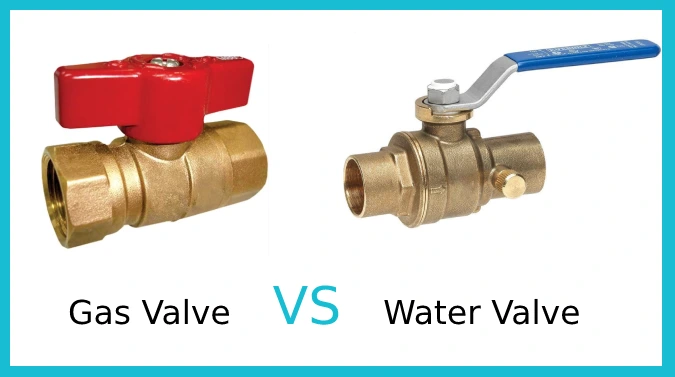
However, the 40-gallon propane water heater often features a self-powered gas valve that ensures operation even during power outages, providing reliable hot water supply.
Hot Water Capacity
Both 40- and 50-gallon water heaters deliver a specific amount of hot water during the first hour, known as the first-hour rating. This directly impacts your household’s ability to meet peak demand.
A 40-gallon model typically provides 60–70 gallons, while a 50-gallon can deliver 70–80 gallons at 40,000 BTU input. You can expect even higher output at 50,000 BTU. This difference matters if your household faces simultaneous high usage.
Stratified layering within the tank affects the available hot water. Hotter water stays near the top while cooler layers settle below, influencing how much usable hot water you draw before reheating begins.
Choosing between these sizes hinges on your peak demand and daily consumption needs. This ensures you won’t run short during critical times without overinvesting in capacity you won’t fully utilize.
Knowing the water heater’s age helps optimize maintenance and performance for your chosen capacity.
Recovery Rate Comparison
Although hot water capacity determines the volume available during peak usage, the recovery rate dictates how quickly your water heater replenishes that supply. A 40-gallon unit at 40k BTU recovers 30–35 gallons per hour with a 90°F rise.
In contrast, a 50-gallon unit at the same BTU recovers 35–40 gallons, improving efficiency by reducing downtime. Increasing BTU input to 50k on the 50-gallon model boosts recovery to 45–50 gallons per hour.
Thermal stratification within the tank influences recovery by layering water temperatures, affecting how quickly hot water is available. Standby losses also impact overall performance; larger tanks may lose more heat over time but typically compensate with better insulation.
Choosing a 50-gallon model with a higher recovery rate suits high-demand households needing consistent hot water without long waits. Regular flushing to prevent sediment buildup can help maintain optimal recovery rates and prolong the heater’s efficiency.
Why Water Heater BTU Ratings Matter More Than Tank Size?
Understanding water heater BTU ratings is crucial because they directly influence the unit’s recovery rate and overall efficiency, often more than the tank size itself.
Water heater BTU ratings significantly impact recovery speed and efficiency, often outweighing tank size considerations.
BTU importance lies in its role as a measure of the energy input, dictating how quickly the water heater can raise water temperature.
Input optimization guarantees that the heater meets your household’s hot water demand without unnecessary energy waste.
For example, a 50-gallon water heater with a 50,000 BTU input recovers hot water faster than a 40,000 BTU unit, regardless of tank size.
This means you get more efficient hot water delivery during peak use.
Choosing heating elements with the proper wattage and voltage ensures safe and efficient operation, directly impacting the water heater’s performance.
Space and Installation Differences Between 40- and 50-Gallon Tanks
While BTU ratings markedly impact performance, the physical dimensions and installation requirements of your water heater also play a key role in your decision. A 50-gallon tank is physically larger, demanding more installation clearance and potentially stricter venting requirements compared to a 40-gallon unit. This affects where you can place the heater, especially in confined spaces.
| Aspect | 40-Gallon Tank |
|---|---|
| Height | Typically 48-52 inches |
| Diameter | 18-20 inches |
| Installation Clearance | Minimal clearance required |
| Venting Requirements | Standard venting for capacity |
| Space Needed | Compact, fits tighter spaces |
For a 50-gallon tank, expect increased clearance and possible venting upgrades to comply with safety codes. This ensures optimal performance in your installation area. If transporting or installing in tight spaces, consider the risks of side transport to avoid damage and ensure longevity.
Energy Costs and Savings of 40 vs. 50 Gallon Tanks
Because energy consumption directly affects your utility bills, comparing the operating costs of 40- and 50-gallon water heaters is essential.
Typically, a 40-gallon unit costs $18–$30 monthly, while a 50-gallon model runs $20–$32, reflecting its higher capacity and slightly increased energy use.
A 40-gallon water heater costs $18–$30 monthly; a 50-gallon runs $20–$32 due to higher capacity.
However, the 50-gallon tank’s quicker recovery rate reduces energy waste during peak demand.
Over the operational lifespan, both require similar maintenance costs, but the 50-gallon’s enhanced insulation and efficiency can translate to marginal savings.
Keep in mind that investing in a 50-gallon unit may offer better long-term value if your household regularly approaches or exceeds the 40-gallon capacity limit.
Efficient operation and consistent maintenance will optimize savings regardless of tank size.
Additionally, choosing a model with a high Uniform Energy Factor (UEF) rating ensures greater energy efficiency and lower utility bills over time.
How Your Hot Water Needs Impact Tank Size?
When you assess your household’s hot water consumption, choosing the right tank size becomes essential to avoid shortages or excess energy use.
Your peak usage fluctuates with seasonal demand, often increasing in colder months when more hot water is required.
A 50-gallon tank offers higher first-hour delivery and faster recovery rates, accommodating these spikes better than a 40-gallon model.
Additionally, if your fixture scheduling overlaps, such as multiple showers or appliances running simultaneously, the larger tank prevents depletion and maintains consistent temperature.
Conversely, if your household’s hot water needs are moderate with staggered fixture use, a 40-gallon tank may suffice.
Carefully analyzing your daily consumption patterns, peak demands, and fixture scheduling helps you select a tank size that balances efficiency, capacity, and energy costs effectively.
Indoor water heaters generally provide better energy efficiency and freeze protection, making them a preferred choice in colder climates with controlled environments, thanks to features like condensing technology.
Frequently Asked Questions
How Long Do 40- and 50-Gallon Water Heaters Typically Last?
You can expect the typical lifespan of both 40- and 50-gallon water heaters to be around 8 to 12 years, depending on usage and maintenance.
When your unit nears this expected lifespan, you should prepare for replacement.
The replacement cost difference between the two sizes is minimal, but the 40-gallon option usually costs less upfront.
Regular inspections can help extend your water heater’s service life and optimize your investment.
Are There Any Safety Concerns Specific to 50-Gallon Tanks?
You should be aware that 50-gallon tanks can experience thermal stratification, where water layers form at different temperatures. This can potentially affect efficiency and safety.
Ensuring proper temperature settings minimizes risks like scalding.
Additionally, seismic anchoring is vital, especially in earthquake-prone areas, to prevent the tank from tipping or damaging connections.
Following installation guidelines for anchoring and maintenance helps you safely operate a larger tank without specific hazards beyond standard water heater safety.
Can I Convert a 40-Gallon Heater to a 50-Gallon Heater Easily?
Sure, just wave your magic wrench and poof! Your 40-gallon tank becomes a 50-gallon marvel.
In reality, tank sizing isn’t that simple. You’ll face installation challenges like fitting the larger unit into the existing space, adjusting plumbing, and possibly upgrading venting or electrical connections.
It’s more efficient and safer to replace the whole unit rather than attempt a conversion that doesn’t technically exist.
Plan for space and code compliance instead.
Do 50-Gallon Water Heaters Require Special Maintenance?
Yes, 50-gallon water heaters require annual inspections to guarantee peak performance and safety.
You’ll want to check the sacrificial anode regularly, as it prevents tank corrosion and extends the heater’s lifespan.
While maintenance steps are similar to smaller tanks, the larger capacity means you should be vigilant about sediment buildup and pressure relief valve function.
Following these maintenance routines helps you avoid costly repairs and maintain efficiency.
Final Verdict: 40 Gallon Water Heater vs 50 Gallon
Choosing between a 40- and 50-gallon water heater is like selecting the right engine for your daily drive. Both power your home, but one matches your route better.
Consider your hot water demand, space constraints, and energy efficiency like gears shifting smoothly to optimize performance.
By focusing on BTU ratings and recovery rates, you guarantee your system runs lean and mean, delivering consistent heat without wasting energy or space.
Make your choice with precision for a seamless, efficient hot water flow.
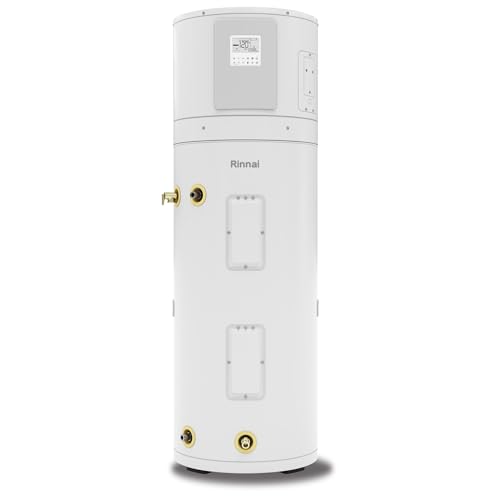
- Energy-efficient performance: Energy Star Certified. Extracts heat from ambient air to deliver...
- High first-hour delivery: Provides up to 73 gallons of hot water in the first hour—ideal for...
- Demand-Response Enabled: Saves you money by communicating with local utilities to reduce energy...
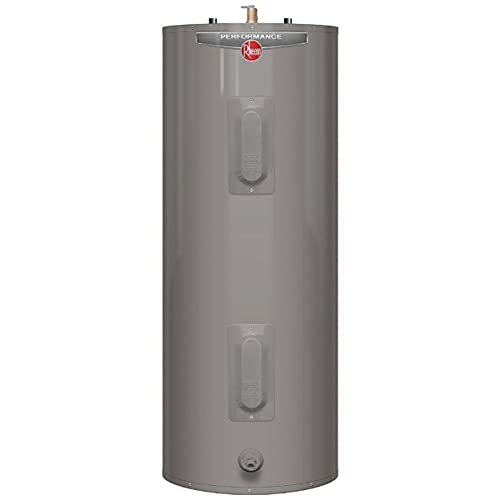
- Rheemglas lined tank
- R-Foam insulation
- Anode Rod protects against corrosion
Last update on 2026-10-15 / Affiliate links / Images from Amazon Product Advertising API