Last Updated on August 3, 2026
When choosing between Fernco and No-Hub couplings, consider flexibility, load, and pipe materials.
Fernco’s flexible rubber sleeve suits misaligned, low-pressure, underground, or temporary repairs with mixed pipes like PVC and cast iron.
No-Hub offers rigid, load-tested connections ideal for permanent, aboveground cast iron systems needing higher shear resistance.
Installation environment and local codes heavily influence your choice.
Understanding their strengths, limitations, and compliance can guide ideal coupling selection for durable, leak-proof joints.

- UNMATCHED QUALITY & PERFORMANCE: Built for a 50-year service life, Fernco couplings are made from…
- FLEXIBLE FIT: To choose the right coupling, measure the outside diameter (OD) of your pipe. This…
- CONNECT VARIOUS PIPE TYPES: The Fernco 1056-100 coupling connects Plastic (PVC, ABS, CPVC, Smooth…

- NO HUB COUPLING: Stainless steel no-hub pipe coupling is designed for use in joining hub-less cast…
- DURABLE: No hub pipe fitting is constructed with corrugated stainless steel for long-lasting…
- EASY TO USE: The stainless steel clamps of the no hub pipe coupling can be easily adjusted with a…

Key Takeaways
- Fernco couplings are flexible rubber sleeves suited for misaligned, underground, and low-pressure pipe joints, compatible with multiple pipe materials.
- No-Hub couplings are rigid metal bands with neoprene sleeves, designed for stable, load-bearing, aboveground cast iron pipe connections.
- Fernco offers elasticity and ease of installation for temporary or buried repairs, while No-Hub provides higher shear resistance and long-term durability aboveground.
- Local codes often restrict unshielded Fernco use aboveground due to potential shear failure, favoring shielded No-Hub for exposed, high-load applications.
- No-Hub couplings deliver over 20 years of service in harsh environments; Fernco lifespan is shorter, especially when exposed to moisture or chemicals.
Fernco vs No Hub Comparison: Flexibility, Strength, and Pipe Compatibility
| Comparison Point | Fernco Coupling | No Hub Coupling | Best Choice |
|---|---|---|---|
| Main Design | Uses a flexible rubber sleeve secured with clamps | Uses a neoprene sleeve with rigid metal shielding | Fernco for flexibility |
| Pipe Compatibility | Works with PVC, cast iron, copper, and galvanized pipe | Mainly designed for hubless cast iron systems | Fernco for mixed pipes |
| Flexibility | Handles misalignment and slight pipe movement well | Creates a more rigid, stable joint | Fernco for uneven joints |
| Shear Resistance | Lower shear support, especially if unshielded | Offers higher shear resistance and load-tested strength | No Hub for structural support |
| Best Location | Common for underground, buried, or temporary repairs | Better for aboveground permanent cast iron work | Depends on installation area |
| Installation Ease | Simple to install with basic pipe alignment and clamp tightening | Needs careful sleeve placement and even bolt tightening | Fernco for quick repairs |
| Code Compliance | May be restricted aboveground in some locations | Often preferred where shielded couplings are required | No Hub for code-sensitive jobs |
| Durability | Can last well indoors but may degrade faster with moisture or chemicals | Often provides longer exposed service life | No Hub for long-term durability |
| Best Use Case | Low-pressure drains, transitions, misaligned joints, mixed pipe repairs | Permanent cast iron joints, high-shear areas, exposed plumbing | Match to pipe and load needs |
| Overall Value | Practical for flexible repair situations | Stronger for permanent, rigid drainage systems | Choose by application demands |
Fernco vs No-Hub Couplings: Key Differences and Uses

Although both Fernco and No-Hub couplings serve to join pipes and prevent leaks in drainage systems, they differ markedly in design, material compatibility, and application.
Fernco couplings use flexible rubber sleeves ideal for connecting various pipe materials like copper, PVC, and galvanized steel, especially in underground or intermediary scenarios.
In contrast, No-Hub couplings consist of rigid metal bands with neoprene sleeves, primarily tailored for hubless cast iron systems aboveground.
You should select Fernco when accommodating misaligned or moving joints due to its elasticity.
No-Hub’s rigidity suits static, high-shear conditions demanding durable, load-tested connections.
Usage depends on factors like pipe material, environmental exposure, and local codes.
You must evaluate these parameters carefully to guarantee peak performance and compliance.
Additionally, proper installation and maintenance, including the use of a check valve where necessary, can significantly enhance system longevity and functionality.
What Are Fernco and No-Hub Couplings?
Let’s talk about Fernco and No-Hub couplings. Fernco couplings are these handy flexible rubber sleeves, usually made from neoprene or EPDM. They work really well with a variety of pipes, like copper, PVC, cast iron, and galvanized steel. So, if you’ve got a mix of pipes, Fernco has you covered!
Now, on the other hand, we’ve No-Hub couplings. These are a bit different. They consist of metal bands paired with neoprene liners and are specifically designed for rigid, hubless cast iron pipe systems. Both types are great at securing pipes and preventing leaks, but they do have their distinct advantages.
Fernco couplings are super adaptable, especially when you’re dealing with misaligned joints. Meanwhile, No-Hub couplings are all about providing a strong, load-resistant connection. So, depending on your needs, you might choose one over the other! Additionally, choosing materials with superior corrosion resistance can significantly extend the lifespan of your piping connections.
Definition and Composition
When connecting drainage pipes, you’ll encounter two main types of couplings: Fernco and No-Hub.
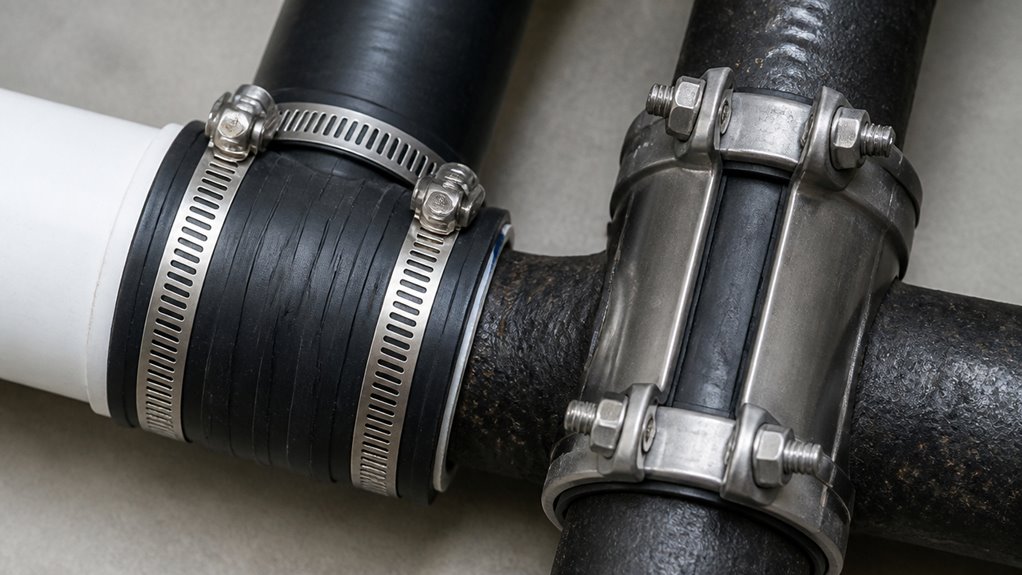
Fernco couplings consist of a flexible rubber boot made from neoprene or EPDM, secured by a metal clamp. This design offers adaptability for misaligned or moving joints.
In contrast, No-Hub couplings use a rigid metal band tightened over a neoprene sleeve. This provides a stable, load-tested connection primarily for hubless cast iron pipes.
The No-Hub’s metal band often includes stainless steel shielding for high-pressure applications.
Both types create leak-resistant seals but differ fundamentally in composition and rigidity. Understanding these distinctions helps you select the appropriate coupling based on pipe material and application demands.
This ensures effective, code-compliant drainage system connections. Installing components with durable materials can improve the reliability and lifespan of your drainage system.
Pipe Compatibility Range
Both Fernco and No-Hub couplings accommodate a range of pipe materials, but their compatibility varies considerably.
You’ll find Fernco works well with copper, PVC, cast iron, and galvanized steel, making it versatile for mixed-material connections. No-Hub couplings primarily suit hubless cast iron systems, focusing on rigid, load-bearing joints.
Choosing the right coupling depends on pipe type and application environment. Proper handling and preparation, such as cutting and threading galvanized pipe correctly, can improve coupling performance and durability.
| Pipe Material | Fernco Compatibility | No-Hub Compatibility |
|---|---|---|
| Cast Iron | Yes | Yes |
| PVC | Yes | Limited |
| Copper | Yes | No |
| Galvanized Steel | Yes | No |
| Hubless Cast Iron | Limited | Yes |
Understanding these compatibility ranges ensures you select the best coupling for durability and code compliance.
Function and Flexibility
Understanding pipe compatibility sets the stage for examining how Fernco and No-Hub couplings function and respond to system demands.
When you work with Fernco couplings, you benefit from their flexible rubber design, ideal for accommodating misaligned or slightly moving pipes.
In contrast, No-Hub couplings provide a rigid, load-tested connection suited for static systems requiring high shear resistance.
Your choice depends on the application’s movement and load requirements.
Fernco offers elasticity for dynamic joints and uneven pipe alignment.
No-Hub delivers structural rigidity for high-shear, long-term installations.
Fernco suits underground, low-pressure, or temporary repairs.
No-Hub is engineered for aboveground, permanent, high-load scenarios.
This functional distinction guides you to select the coupling that best fits your system’s mechanical demands, especially considering how material quality affects durability and performance.
When to Use Fernco Vs No-Hub Couplings?
When it comes to choosing between Fernco and No-Hub couplings, it’s important to consider your specific application. You’ll typically want to reach for Fernco couplings for underground situations. They’re great for flexibility and can handle low shear loads, especially when you’re transitioning between cast iron and PVC.
On the other hand, No-Hub couplings are your go-to for aboveground applications. They’re specifically designed for static, high-shear systems, making them perfect for situations where you need rigid, load-tested connections—especially for cast iron repairs. Additionally, No-Hub couplings contribute to better noise reduction, which is beneficial in residential and commercial plumbing systems.
Underground Vs Aboveground
When choosing between Fernco and No-Hub couplings, the installation environment plays a critical role in determining the appropriate type.
For underground applications, Fernco couplings are preferred due to their flexibility and ASTM C1173 compliance. They accommodate cast iron-to-PVC shifts and soil movement.
Aboveground, No-Hub couplings dominate because of their rigidity and higher shear resistance. They comply with ASTM C1277 and CISPI 310 standards, especially for exposed cast iron piping.
Use Fernco underground for buried drainage where flexibility and corrosion resistance are key.
Choose No-Hub aboveground for static, high-shear cast iron repairs or new installations.
Avoid unshielded Fernco aboveground due to shear failure risks in some jurisdictions.
Confirm local codes since they may restrict coupling types based on exposure and load conditions.
Load And Shear Requirements
Although both Fernco and No-Hub couplings serve to join pipes securely, their suitability hinges on load and shear demands.
You’ll want to choose Fernco for low-shear applications like underground cast iron-to-PVC connections, where flexibility and slight movement are acceptable.
Fernco’s neoprene sleeve offers limited shear resistance, making it unsuitable for aboveground use in jurisdictions restricting unshielded couplings due to potential shear failure.
Conversely, No-Hub couplings provide rigid, load-tested connections with high shear resistance. They’re ideal for static, aboveground cast iron systems subject to structural loads or code mandates.
Shielded No-Hub bands add stainless steel for heavy-duty, high-pressure scenarios, ensuring long-term durability.
Always assess the expected shear forces and local codes before selecting, as improper use risks joint failure and leaks.
For applications demanding maximum strength and durability, stainless steel wedge anchors demonstrate superior corrosion resistance, highlighting the importance of material choice in load-bearing fixtures.
How Long Do Fernco and No-Hub Couplings Last?
Understanding the lifespan of Fernco and No-Hub couplings is essential for selecting the right product and planning maintenance schedules.
Fernco couplings typically last 10–20 years indoors under ideal conditions but degrade faster, 5–10 years, when exposed to moisture, chemicals, or burial.
No-Hub shielded couplings provide over 20 years of reliable service in aboveground, exposed environments due to their metal band and neoprene sleeve design, which resists shear and environmental stress better.
Key factors influencing lifespan include:
- Exposure to moisture, chemicals, and burial conditions
- Mechanical stresses such as shear loads and pipe movement
- Material compatibility and proper application
- Signs of aging: hardened gaskets, buckled shields, and leaks
Regular inspection helps you avoid unexpected failures and guarantees system integrity. Using corrosion-resistant coatings on metal components can further extend coupling durability in harsh environments.
Installation Tips for Fernco and No-Hub Couplings
Assure a secure and leak-free connection by following precise installation techniques for Fernco and No-Hub couplings.
For Fernco, guarantee pipe ends are clean, free of debris, and properly aligned to maintain the sleeve’s flexibility and sealing integrity.
Slide the neoprene boot fully over both pipe ends, then tighten the metal clamp uniformly to avoid uneven pressure that could cause leaks or damage.
With No-Hub couplings, position the neoprene sleeve over the joint before securing the metal band.
Tighten bolts evenly to prevent distortion of the sleeve or pipe misalignment. Avoid overtightening, which risks crushing the sleeve or stripping bolts.
Use basic hand tools and confirm that materials match the coupling specifications to guarantee the coupling’s performance under expected shear and pressure conditions.
For underground installations, it is important to use fittings made from dezincification-resistant brass to ensure long-term corrosion resistance and durability.
Choosing Couplings Based on Codes and Applications
When selecting couplings for your plumbing system, you must prioritize local codes and specific application requirements to guarantee compliance and optimal performance.
Fernco couplings suit underground cast iron-to-PVC transitions, meeting ASTM C1173. No-Hub couplings comply with ASTM C1277 and CISPI 310 standards for aboveground, high-shear installations. Your choice hinges on pipe materials, load demands, and exposure conditions.
Consider these factors:
Use Fernco for flexible, low-shear, underground or temporary repairs. Opt for shielded No-Hub where rigidity and shear resistance are code-mandated. Verify jurisdictional restrictions on unshielded Fernco aboveground use. Select adaptor couplings for dissimilar pipe materials requiring ASTM C1460 compliance.
Aligning coupling types with codes guarantees durability, safety, and adherence to regulatory standards. Additionally, ensuring the correct fuse size is critical in protecting connected electrical components in plumbing-related pump systems.
Frequently Asked Questions
Can Fernco Couplings Be Reused After Removal?
You generally shouldn’t reuse Fernco couplings after removal.
Their neoprene or EPDM rubber sleeve compresses and deforms during installation, which compromises the seal integrity upon reuse.
Reusing increases the risk of leaks, especially if the gasket hardens or clamps lose tension.
For reliable, leak-free connections, always replace the coupling with a new one.
Ensure it meets the required ASTM standards and suits the pipe materials and conditions.
What Tools Are Best for Tightening No-Hub Clamps?
Tightening no-hub clamps is like tuning a guitar string; you need just the right tension. You’ll want a torque wrench or a sturdy adjustable wrench to apply consistent, even pressure to the bolts.
Over-tightening risks stripping screws; under-tightening invites leaks. Using a torque wrench set to manufacturer specs guarantees a secure, leak-free seal. Hand tools with good grip and precision deliver the best results for these metal band clamps.
Are There Eco-Friendly Alternatives to Fernco or No-Hub?
You can consider couplings made from recycled rubber or biobased elastomers as eco-friendly alternatives.
Some manufacturers offer silicone-based sleeves, which provide durability with lower environmental impact.
Additionally, stainless steel clamps combined with reclaimed or sustainably sourced rubber sleeves reduce landfill waste.
While these alternatives meet some industry standards, verify their compatibility with your pipe materials and local codes to guarantee performance and compliance.
Always weigh environmental benefits against functional requirements.
How Do Temperature Changes Affect Coupling Performance?
You’ll notice temperature changes impact coupling performance by causing material expansion, contraction, and stress.
Rubber sleeves in couplings soften in heat, risking leaks, and stiffen in cold, risking cracks.
Metal bands may expand or contract, loosening clamps or stressing seals.
Proper selection and installation account for thermal cycling, ensuring seals remain tight.
You must consider operating temperature ranges to maintain coupling integrity and prevent premature failure in fluctuating environments.
Can No-Hub Couplings Be Painted or Coated After Installation?
Yes, you can paint or coat no-hub couplings after installation, but you need to use compatible coatings that won’t degrade the neoprene sleeve or metal band.
Avoid solvents or acidic paints that might cause corrosion or rubber deterioration.
Applying a corrosion-resistant paint on the metal band can extend its lifespan, especially in exposed environments.
Always make certain the coupling remains accessible for inspection and maintenance after coating.
Final Verdict on Fernco Vs No Hub
Now that you know the key differences between Fernco and No-Hub couplings, the choice might seem straightforward. But don’t jump to conclusions just yet. Each has unique strengths depending on your project’s demands, codes, and longevity needs.
Before you decide, consider the critical factors of installation ease, durability, and compliance. Your next step? Analyze your specific application carefully to make certain you choose the coupling that won’t just fit but perform flawlessly.


- Heavy-Duty Stainless Steel Build – Designed for strength and durability, this coupling securely…
- Red Color Shield – Features a bright red shield for quick, easy identification during…
- Heavy-Duty Construction – Features 304 series stainless steel bands with a corrugated stainless…
Last update on 2026-10-13 / Affiliate links / Images from Amazon Product Advertising API