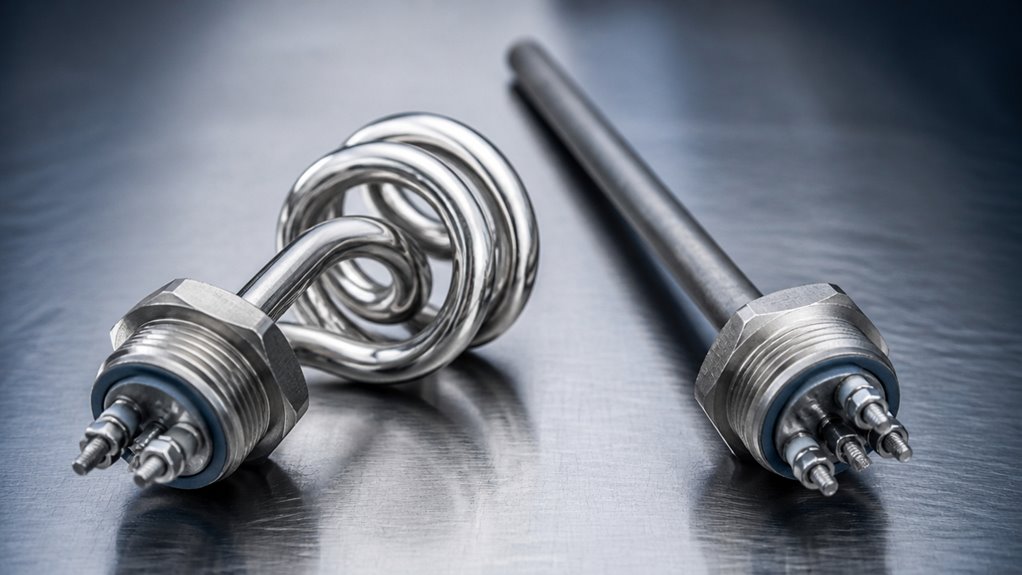
You’ll want to choose deluxe or straight water heater elements based on your tank’s internal clearance and heating needs.
Straight elements fit tanks with ample linear space and provide consistent heating along their length. However, they may unevenly heat taller tanks.
Deluxe elements, often bent or curved, match specific tank geometries for better heat distribution. They also include gaskets for secure installation.
Material, voltage, and length compatibility are vital to guarantee efficiency and avoid damage. Exploring these factors further helps optimize your system’s reliability and performance.
Key Takeaways
- Deluxe elements feature custom bends for specific tank designs, enhancing heat distribution and fit compared to straight elements’ linear shape.
- Straight elements are simple, extend directly into tanks, and require ample clearance for installation and uniform heating along their length.
- Deluxe elements often include gaskets and installation instructions, needing precise alignment for effective sealing and operation.
- Straight elements may cause uneven heating in taller tanks, while deluxe elements maximize surface contact to promote uniform heat distribution.
- Material and design of deluxe elements enhance durability and heat dispersion, unlike standard straight elements that offer basic functionality.
Deluxe Water Heater Element vs Straight: Key Differences in Design, Heating, and Installation
| Comparison Factors | Deluxe Water Heater Element | Straight Water Heater Element |
|---|---|---|
| Element Design | May feature bent, curved, or specialized construction | Features a straight, linear configuration |
| Primary Purpose | Designed for specific replacement or installation requirements | Provides straightforward water heating in compatible tanks |
| Element Shape | Varies by product and heater model | Straight tube extending into the tank |
| Tank Clearance | May accommodate particular internal layouts | Requires sufficient straight-line clearance |
| Element Length | Varies according to model and configuration | Available in different standard and model-specific lengths |
| Heating Performance | Depends on wattage, surface area, and design | Depends on wattage, surface area, and design |
| Heat Distribution | Curved designs may position the heated surface differently | Provides heat along its straight element surface |
| Material Options | May include copper, stainless steel, or Incoloy | May also include copper, stainless steel, or Incoloy |
| Corrosion Resistance | Depends on sheath material and water conditions | Depends on sheath material and water conditions |
| Voltage and Wattage | Must match approved heater specifications | Must match approved heater specifications |
| Mounting and Sealing | Requires compatible mounting and gasket | Requires compatible mounting and gasket |
| Installation Considerations | Shape may require additional clearance checks | Straight design may simplify physical insertion |
| Durability | Depends on material, water quality, and operating conditions | Depends on material, water quality, and operating conditions |
| Maintenance Needs | May experience mineral scaling and corrosion | May experience mineral scaling and corrosion |
| Replacement Compatibility | Verify model, shape, mounting, and electrical ratings | Verify model, length, mounting, and electrical ratings |
| Overall Recommendation | Choose when the specific design is approved for your heater | Choose when the straight replacement meets all specifications |
Which Water Heater Element Should You Choose: Deluxe or Straight?

When deciding between deluxe and straight water heater elements, you should carefully assess your tank’s internal clearance and specific heating requirements.
Assess your tank’s space and heating needs before choosing between deluxe and straight water heater elements.
Straight elements extend directly into the tank without bending, making them suitable for tanks with ample internal space. They come in standard lengths—8, 9, 13, and 15 inches and are widely compatible with many brands when matched for wattage and voltage.
Deluxe elements, on the other hand, offer tailored designs often bundled with gaskets and instructions, prioritizing fit and durability. These elements may use materials like stainless steel, copper, or incoloy and cater to specific heater models or double-element units.
Choosing between them hinges on your tank’s spatial constraints and the need for precise fit. Improper clearance or shape can cause installation failure or suboptimal heating performance.
For best results, it is also important to match element voltage exactly to your water heater’s specifications to ensure safe and efficient operation.
Matching Water Heater Element Size and Shape to Your Tank
When you’re choosing a water heater element, it’s really important to check that its length and diameter fit comfortably within your tank’s available space. This ensures a smooth installation process.
Also, don’t overlook the shape of the element. Straight elements need a clear path for installation, while bent or deluxe designs can work with different internal layouts.
Choosing an element with the correct flange-to-tip length and compatible mounting type helps avoid uneven heating and leaks.
Element Dimensions Importance
Although selecting a water heater element may seem straightforward, matching the element’s size and shape precisely to your tank is vital for proper installation and peak performance.
You need to measure the length and confirm the shape: straight or bent. This ensures the element fits without obstruction inside the tank.
Incorrect dimensions can prevent full insertion, cause poor contact with the tank’s interior, or lead to uneven heating.
For straight elements, verify standard lengths like 8, 9, 13, or 15 inches match your tank’s specifications.
Deluxe elements may have custom bends or curves tailored to specific boiler designs, requiring exact shape conformity.
Precise dimension matching guarantees optimal heat transfer, prevents installation damage, and maintains system efficiency.
Always cross-check element specs against your tank’s internal layout before purchasing or installing.
Additionally, performing regular maintenance checks on the tank and its components helps ensure long-lasting performance and prevents costly repairs.
Tank Clearance Considerations
Since proper tank clearance directly impacts the successful installation and operation of your water heater element, you must carefully assess the internal space available before selecting the element size and shape.
Measure the tank’s insertion depth and verify the element length won’t interfere with internal components or the tank bottom.
Straight elements require sufficient linear clearance, as their rigid form extends directly inward without bending.
If your tank’s internal layout restricts straight insertion, you risk improper seating or damage.
Confirm that the element’s flange diameter matches the tank opening to maintain a tight seal.
Additionally, check for adequate clearance around the element to prevent direct contact with the tank shell, which could cause heat damage or corrosion.
Accurate clearance evaluation guarantees reliable heating performance and element longevity.
Also, be aware that sediment buildup at the tank bottom can increase heating element workload and runtime, affecting element performance and energy use, so regular maintenance is essential to prevent sediment accumulation.
Shape Compatibility Factors
When selecting a water heater element, ensuring the correct size and shape alignment with your tank’s internal configuration is essential to proper function and longevity.
Straight elements require sufficient clearance to insert fully without contact with tank walls or internal components. Deluxe elements often feature curved or bent designs tailored to specific tank geometries, improving fit and heat distribution.
Matching element length and shape prevents installation issues and potential damage.
| Element Type | Common Lengths (in.) | Compatibility Notes |
|---|---|---|
| Straight | 8, 9, 13, 15 | Fits larger tanks with ample space |
| Deluxe | Varied | Designed for specific tank layouts |
| Bent | Custom | Ideal for limited clearance tanks |
| Universal | Multiple | Broad compatibility, less precise |
| Double | Specific | For dual-element heaters |
Choose elements based on precise tank measurements and manufacturer specs. Proper maintenance and safety precautions, such as disconnecting power before servicing, are critical to prevent hazards during installation or replacement of water heater elements as advised by experts’ safety guidelines.
Comparing Materials, Durability, and Heating Performance
When you’re picking a water heater element, it’s super important to think about what it’s made of. You’ve got options like stainless steel, copper, and incoloy, and each one has its own perks when it comes to resisting corrosion and transferring heat.
Your choice really affects how efficiently your heater works. Some materials do a better job at keeping the temperature steady and lasting longer. So, by understanding these differences, you can make sure you’re choosing an element that meets your heater’s performance needs and will hold up over time.
Material Types and Benefits
How do material choices in water heater elements impact their durability and heating efficiency? When selecting between deluxe and straight elements, you’ll encounter stainless steel, copper, and incoloy as primary materials.
Stainless steel offers robust corrosion resistance and is common in screw-in models, ensuring longevity. Copper provides excellent thermal conductivity, enhancing heat transfer but can be prone to corrosion in harsh water conditions.
Incoloy excels in dry-fire resistance and sustains performance under high temperatures, making it ideal for demanding applications. The material’s thermal conductivity directly influences heating speed, while corrosion resistance affects element lifespan.
Choosing the right material depends on your water quality and heater design, as durability and thermal efficiency hinge on these properties to optimize overall heating performance without premature failure. Additionally, elements made with stainless steel or aluminum alloys are often preferred in compact electric heaters due to their corrosion resistance and durability.
Heating Efficiency and Longevity
Although material choice greatly influences both heating efficiency and longevity, it’s essential to understand how each element composition interacts with operating conditions.
Stainless steel offers superior corrosion resistance and thermal stability, extending element lifespan while maintaining steady heat transfer.
Copper elements provide excellent thermal conductivity but may degrade faster in aggressive water conditions.
Incoloy excels in dry-fire resistance, reducing failure risks during low-water scenarios.
Straight elements typically deliver consistent heating along their length but may cause uneven heat distribution in taller tanks due to limited surface contact.
Deluxe elements, often crafted from advanced alloys, enhance durability and optimize heat dispersion through tailored shapes.
Matching wattage and voltage precisely guarantees efficient energy use and prevents premature burnout.
Proper material and design selection directly impacts your water heater’s operational reliability and maintenance frequency.
Regular maintenance such as annual flushing can also help prevent sediment buildup that adversely affects element performance and longevity.
Installation Differences for Deluxe and Straight Water Heater Elements
Because deluxe and straight water heater elements differ markedly in design and fit, their installation processes require distinct considerations.
Straight elements screw in directly and need sufficient tank clearance. Deluxe elements often feature bent shapes or specific materials, requiring precise alignment and gasket installation. You must match element type to tank design to guarantee proper contact and avoid installation issues.
| Installation Aspect | Straight Element | Deluxe Element |
|---|---|---|
| Shape | Linear, inserts straight | Bent/curved, tailored fit |
| Installation Tool | Standard wrench/socket | May need additional alignment tools |
| Gasket Requirement | Standard flat gasket | Often supplied with kit, precise fit |
Tailoring installation to element type ensures durability and peak heating performance. Regular inspections can help prevent issues caused by corrosion or rust that may affect element connections.
Safe Replacement and Maintenance Tips for Water Heater Elements
When replacing a water heater element, you must first shut off power to the unit and verify the tank water level is below the element to prevent electrical hazards and water leakage.
Use a suitable wrench or socket to loosen the element, ensuring you remove the old gasket completely.
Install a new gasket to maintain a watertight seal and avoid leaks.
Confirm the replacement element matches the original’s wattage and voltage ratings to prevent damage or inefficiency.
Tighten the element securely but avoid overtightening, which can damage threads.
After installation, restore power and test the heater for proper operation and leaks.
Periodically inspect elements for corrosion or sediment buildup, and flush the tank to extend element lifespan and maintain efficient heating.
Knowing the water heater’s manufacture date can help plan timely maintenance and avoid unexpected failures.
How Element Design Impacts Heating Efficiency and Heat Distribution?
Understanding how the design of water heater elements influences heating efficiency and heat distribution helps you optimize performance and longevity.
Straight elements provide consistent heat along their length, ideal for tanks with adequate clearance. However, they may cause uneven heating in taller tanks due to limited surface contact.
Deluxe elements, often bent or curved, conform to tank geometry, promoting uniform heat distribution by maximizing contact with water and tank surfaces.
Material choice—stainless steel, copper, or incoloy—further affects thermal conductivity and corrosion resistance, impacting efficiency and lifespan.
Wattage and voltage ratings must match your system to guarantee proper heat output without overloading.
Regular flushing is recommended to prevent sediment buildup on elements, which can reduce efficiency and cause overheating.
Frequently Asked Questions
Can Deluxe Elements Reduce Energy Consumption Compared to Straight Elements?
Deluxe elements can reduce energy consumption if their design improves heat distribution and matches your tank’s internal layout precisely.
Because they often use advanced materials like stainless steel or incoloy, they resist corrosion and maintain efficiency longer.
By ensuring better contact and tailored fit, they minimize heat loss.
However, energy savings depend on proper wattage matching and installation.
Simply switching to deluxe elements won’t guarantee lower consumption without correct specifications.
Are Deluxe Elements Compatible With All Water Heater Brands?
You won’t find a deluxe element that magically fits every water heater brand on the planet.
Deluxe elements are designed with specific boiler or heater models in mind, meaning their compatibility isn’t universal.
You’ll need to check exact model numbers, materials, and shape to guarantee a perfect fit.
Trying to force a deluxe element into an incompatible tank risks poor installation, leaks, or even damage, so precise matching is essential.
How Often Should Deluxe Water Heater Elements Be Replaced?
You should replace deluxe water heater elements every 6 to 10 years, depending on water quality and usage.
Hard water causes mineral buildup, reducing efficiency and lifespan.
Regular inspection helps spot corrosion or reduced heating performance.
If you notice inconsistent water temperature or leaks, replace the element promptly.
Always match the new element’s wattage, voltage, and material to your heater’s specifications to guarantee peak durability and function.
Do Deluxe Elements Require Special Tools for Installation?
No, deluxe elements don’t usually require special tools for installation. You’ll typically just need a standard wrench or socket set to remove the old element and secure the new one.
However, deluxe kits often include detailed instructions and a gasket for proper sealing. Make sure you follow those carefully. Always turn off power and drain the tank below the element before starting.
Proper matching of voltage and wattage is essential to avoid damage.
Can Straight Elements Be Upgraded to Deluxe Kits Easily?
Sure, you can “upgrade” your straight element to a deluxe kit if you enjoy playing plumber puzzle master.
But don’t expect it to be plug-and-play. Deluxe kits often require specific fittings and gasket changes designed for certain heaters.
You’ll need to verify compatibility carefully, match wattage and voltage, and make sure tank clearance fits the new shape.
Otherwise, you might end up with a fancy element that just won’t fit or function properly.
Deluxe Water Heater Element vs Straight: Final Verdict
Choosing between deluxe and straight water heater elements depends on matching measurements, material makeup, and maintenance needs.
Deluxe designs deliver dynamic distribution, driving durability and dependable heating. Straight elements simplify setup with straightforward shapes.
You’ll want to weigh wattage, wear resistance, and water tank compatibility carefully to guarantee efficient energy exchange.
By selecting the suited style and following safe, systematic installation steps, you secure seamless, sustained service and superior system safety.