
You’ll notice American toilets are typically two-piece, floor-mounted with siphonic, gravity-fed flushes using about 1.6 gallons per flush.
European models often feature sleek one-piece or wall-mounted designs with concealed tanks. They use efficient dual-flush washdown systems that save water.
European units also tend to have lower seats and compact bowls, while American ones focus on comfort and accessibility.
Installation and maintenance vary widely. Understanding these differences helps you choose what suits your home’s needs best.

- TRADE EXCLUSIVE TANK
- 12-INCH ROUGH-IN
- WATERSENSE CERTIFIED — Uses 20 percent less water and performs as well as or better than regular…
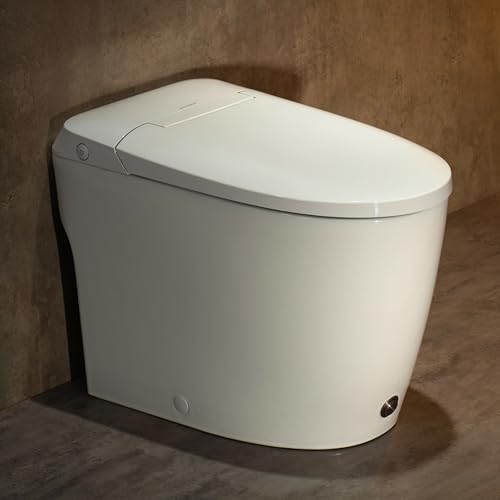
- Air-Pressure Assisted Flush (1.0 GPF): designed with a built-in tank and air pressure-assisted…
- Hands-Free Convenience: 1-piece toilet flush via foot-kick or side-button, ideal for hygienic and…
- Non-Electric Required: features powerful flushing without the need for electricity, making it a…
Key Takeaways
- American toilets are typically two-piece, floor-mounted with a 12″ rough-in, while European models often feature one-piece or wall-mounted designs with concealed tanks.
- European toilets use water-efficient dual-flush washdown systems averaging 4–6 liters per flush, whereas American toilets use siphonic, gravity-fed systems at 1.6 gallons per flush.
- European toilets usually have lower seating heights and circular or elliptical bowls, while American toilets offer comfort heights (17–19 inches) with oval-shaped bowls.
- Installation of European wall-mounted toilets requires reinforced walls and hidden plumbing, making it more complex compared to easier American floor-mounted units.
- European bathrooms often separate toilets for privacy and include bidets, contrasting with combined bathroom layouts and reliance on toilet paper in American homes.
American vs European Toilets Comparison: Design, Flush System, Comfort, and Cost
| Comparison Point | American Toilets | European Toilets | Best Choice |
|---|---|---|---|
| Common Design | Usually two-piece with separate tank and bowl | Often one-piece or wall-mounted with concealed tank | European for sleek design |
| Mounting Style | Mostly floor-mounted | Often wall-mounted or compact floor-mounted | American for easier installation |
| Flush System | Uses siphonic, gravity-fed flushing | Uses washdown and dual-flush systems | European for water efficiency |
| Water Use | Commonly around 1.6 gallons per flush | Often uses 4–6 liters with dual-flush options | European for lower water use |
| Seat Height | Often offers comfort height around 17–19 inches | Usually lower and more compact | American for accessibility |
| Bowl Shape | Round or elongated, often comfort-focused | Circular or elliptical, usually compact | Depends on space and comfort |
| Bathroom Layout | Commonly combines toilet, sink, and shower in one room | Often separates the toilet for privacy | European for private layouts |
| Bidet Use | Less common, often relies on toilet paper | Bidets or bidet functions are more common | European for hygiene features |
| Installation Difficulty | More DIY-friendly with standard rough-ins | Wall-mounted models need reinforced walls and hidden plumbing | American for simple installs |
| Maintenance Access | Easier access to tank and parts | Concealed tanks can be harder to repair | American for easy maintenance |
| Overall Best Use | Great for comfort, accessibility, and simple replacement | Great for compact spaces, modern style, and water savings | Match to bathroom needs |
American vs European Toilet Design Differences

When comparing American and European toilet designs, you’ll notice distinct structural differences that impact both installation and usage.
American toilets typically have a two-piece construction, with a separate tank and bowl joined together.
American toilets usually consist of two parts: a separate tank and a bowl connected together.
European models often feature a one-piece design or a wall-mounted system with a concealed tank inside the wall.
The bowl shapes also differ: American toilets generally have a round or oval bowl with a U-shaped front notch.
In contrast, European toilets use fully circular or elliptical bowls without a notch.
Wall-mounted European units float above the floor, saving space compared to the floor-mounted American units.
These structural variations influence installation complexity, spatial requirements, and maintenance procedures.
It’s essential to take into account your specific needs when selecting between American and European toilet designs.
Many American round toilets are designed with a standard 12″ rough-in to ensure compatibility with existing plumbing and ease of installation.
How Cultural Habits Shape Toilet Use and Bathroom Layouts?
The physical design of toilets directly reflects broader cultural habits that influence how bathrooms are arranged and used.
When you analyze American and European bathrooms, you notice distinct patterns shaped by cultural preferences and practical needs.
For example, Americans prioritize comfort and privacy by combining toilets, sinks, and showers in one space.
In contrast, Europeans often separate toilets into fully enclosed rooms for enhanced privacy.
Consider these cultural influences on bathroom layouts:
- American bathrooms usually feature partial walls, integrating toilet and bathing areas.
- European bathrooms separate toilets to maximize privacy and hygiene.
- Europeans prefer bidets for cleaning, reducing toilet paper use common in the U.S.
- Public restroom designs differ, with Europe favoring trough urinals, unlike individual American units.
These habits directly shape bathroom spatial organization and fixture selection.
Additionally, the adoption of rimless toilets in many modern European bathrooms supports hygiene and ease of cleaning, reflecting a preference for efficient maintenance.
Comparing Flushing Systems and Water Efficiency
Although flushing toilets may seem straightforward, the systems behind them differ markedly between America and Europe, impacting water efficiency and performance.
Flushing toilets vary significantly between America and Europe, influencing both water efficiency and overall performance.
You’ll find American toilets primarily rely on siphonic flushing, creating suction to evacuate waste. In contrast, European toilets use washdown systems that push waste directly into the drain.
American models generally feature a single-handle flush mechanism. Many European toilets use dual-push buttons, allowing you to select a partial or full flush.
This distinction plays a pivotal role in water conservation strategies. American toilets must meet EPA standards of no more than 1.6 gallons per flush, but older models can use considerably more.
European units typically operate between 4 to 6 liters per flush, aligning with their dual-flush options. These technical differences affect not only water consumption but also flushing effectiveness and maintenance requirements.
Many modern American toilets now feature dual-flush technology to improve water efficiency without sacrificing performance.
Why European Toilets Use Less Water?
Understanding the specific design choices and flushing mechanisms in European toilets helps explain their lower water usage compared to American models.
You’ll notice that European units prioritize efficiency through advanced technology and design.
Here’s why European toilets use less water:
- Dual-flush systems let you choose between a 1.1-gallon flush for liquid waste and 1.6 gallons for solids, reducing unnecessary water use.
- Washdown flushing pushes waste directly into the drain, requiring less water than American siphonic flushes.
- Compact, wall-mounted designs minimize water volume needed per flush by optimizing bowl shape and water distribution.
- Stringent European regulations enforce lower maximum flush volumes, keeping average water use between 1.1 and 1.6 gallons per flush.
Additionally, innovations such as optimized trapways and advanced flush valves enable European toilets to maintain strong flushing performance while using less water.
Toilet Height and Comfort Features Compared
You’ll notice that American toilets usually come in standard or comfort heights, which range from 17 to 19 inches. This design choice really enhances accessibility, making it easier for everyone to use.
On the other hand, European models tend to have lower seating. This is often a practical decision, as they’re designed for compact spaces. Plus, many of them integrate bidet functions for added hygiene and comfort. Many European wall-hung toilets also feature dual-flush systems that optimize water efficiency without sacrificing flushing performance.
Standard vs Comfort Height
When selecting a toilet, you’ll notice that height plays a pivotal role in comfort and accessibility, particularly between standard and comfort-height models.
Standard toilets typically measure 15 inches from floor to seat, while comfort-height models range from 17 to 19 inches. This aligns better with average chair height, impacting ergonomics and usability.
Consider these key points:
- Comfort-height toilets reduce strain on knees and hips, aiding users with mobility issues.
- Standard height suits smaller bathrooms and traditional designs.
- ADA-compliant comfort-height models enhance accessibility in public and private spaces.
- European toilets often have lower seating heights, emphasizing space efficiency over comfort height.
Choosing the right height balances ergonomic needs with bathroom layout constraints for the most favorable user experience. Additionally, ADA-compliant heights often range from 17″ to 19″ and are designed to improve sit/stand transitions for users with accessibility needs.
Bidet Integration Differences
Although bidet integration varies widely, it considerably influences toilet height and user comfort between American and European models.
European toilets often incorporate bidet functions directly into the toilet or as a separate fixture. This typically results in a slightly lower seating height to optimize space in smaller bathrooms.
This design prioritizes functionality and hygiene, catering to users accustomed to bidet use. In contrast, American toilets rarely integrate bidets, relying primarily on toilet paper.
They maintain a higher, comfort-oriented height ranging from 17 to 19 inches to comply with ADA standards. The lack of built-in bidet features in American designs simplifies installation but limits hygiene options.
Understanding these differences helps you select a toilet that balances comfort, space, and personal hygiene preferences effectively. Additionally, features such as ADA-compliant seating in American toilets enhance accessibility for users with limited mobility.
Seating Design and Ergonomics
Since toilet ergonomics directly affect user comfort and accessibility, understanding the height differences between American and European models is essential.
American toilets usually range from 17 to 19 inches in height, aligning with ADA-compliant standards to enhance accessibility.
In contrast, European toilets often feature lower seating heights to optimize space in smaller bathrooms.
Key factors to take into account include:
- Height Range: American models favor comfort height. European models prioritize compactness.
- Seat Shape: American toilets often have oval bowls. European bowls are typically circular or elliptical.
- Comfort Features: Americans rely on cushioned seats and accessibility. Europeans integrate bidet functions for hygiene.
- Installation Type: European wall-mounted units allow adjustable height. American floor-mounted units have fixed height.
You’ll notice American designs emphasize comfort and accessibility. European designs focus on functionality and space efficiency. Additionally, many compact models incorporate soft-close seats to enhance user comfort and reduce noise during use.
Installation and Costs: American vs European Toilets
When you’re thinking about installing a toilet, there are some key differences between American and European models that you should be aware of.
For American toilets, you’re usually looking at a floor-mounted, two-piece design. This setup is pretty straightforward and often fits well into DIY projects, making it a more affordable option for many homeowners.
On the other hand, European toilets, especially those sleek wall-mounted ones, come with their own set of challenges. They generally require professional installation and may need some wall reinforcement, which can definitely add to the complexity and cost.
Additionally, many American models utilize gravity-fed systems that offer quieter, clog-resistant performance at 1.6 GPF, balancing practicality and water efficiency.
Installation Complexity
Because wall-mounted European toilets require reinforced walls and concealed plumbing, their installation demands professional expertise and increased labor time. You’ll need to plan carefully to accommodate the hidden tank and ensure wall strength, which complicates the process compared to traditional American floor-mounted toilets.
Consider these installation complexities:
- Structural reinforcement of walls to support the toilet’s weight.
- Routing plumbing inside walls for concealed cisterns.
- Precise alignment and mounting to prevent leaks and instability.
- Specialized tools and skills for in-wall component assembly.
In contrast, American two-piece toilets typically involve straightforward floor mounting and external plumbing connections. This makes them easier and faster to install, especially for DIYers or standard renovations. Additionally, choosing plumbing-friendly materials like septic-safe toilet paper can help maintain system efficiency and reduce long-term maintenance costs associated with complex installations.
Cost Comparison
Understanding the installation requirements is key to evaluating the overall cost differences between American and European toilets. American toilets, typically floor-mounted and two-piece, are more straightforward to install, often allowing DIY projects.
European toilets, especially wall-mounted models, require professional installation and wall reinforcement, increasing labor costs. Additionally, European units tend to be pricier upfront due to advanced flushing systems and design features.
| Aspect | American Toilets | European Toilets |
|---|---|---|
| Base Price | $100 – $300 | $250 – $700 |
| High-End Models | Up to $1,000+ | $600 – $1,200+ |
| Installation Type | Floor-mounted, DIY | Wall-mounted, pro only |
| Installation Cost | Lower | Higher |
| Maintenance | Easier, cheaper | Complex, costly |
You should factor these cost differences when choosing between the two.
Choosing the Right Toilet for Your Home
Although selecting a toilet might seem straightforward, choosing the right model for your home involves evaluating design, flushing efficiency, water usage, and installation requirements.
You’ll want to contemplate these key factors:
- Design and Space: Decide between floor-mounted American two-piece or space-saving European wall-mounted models.
- Flushing System: Choose siphonic flushing common in American toilets or efficient washdown systems with dual-flush options in European models.
- Water Efficiency: Prioritize WaterSense-rated American toilets or European dual-flush units for peak water conservation.
- Installation Complexity: Factor in easier DIY installation for American units versus professional installation and wall reinforcement for European wall-mounted designs.
Frequently Asked Questions
Are American or European Toilets Easier to Repair?
You’ll find American toilets easier to repair since they usually have a two-piece design with accessible tanks and standard parts.
This setup allows straightforward DIY fixes and quick part replacements.
European toilets, especially wall-mounted models, require professional help due to concealed tanks and wall reinforcements.
Their integrated systems and specialized components add complexity, making repairs more challenging and costly compared to the generally simpler, floor-mounted American units.
Which Toilet Type Is More Eco-Friendly Long-Term?
Imagine riding a horse-drawn carriage but choosing the electric car instead. You’d want lasting efficiency.
You’ll find European toilets more eco-friendly long-term due to their dual-flush systems. This feature allows partial flushes that cut water use dramatically.
Their washdown mechanisms use about 0.8 to 1.6 gallons per flush, conserving more water compared to standard models.
Choosing one means you actively reduce consumption, benefiting both your utility bills and the environment over time.
Do European Toilets Require Special Cleaning Products?
You don’t necessarily need special cleaning products for European toilets, but it helps to choose ones compatible with the materials and flushing systems used.
Wall-mounted or ceramic surfaces may require non-abrasive cleaners to avoid damage. For bidet-integrated models, use gentle, pH-balanced cleaners to protect internal components.
Avoid harsh chemicals that could corrode plastic or metal parts. Regular cleaning with appropriate products maintains hygiene and extends the toilet’s lifespan efficiently.
Can American Toilets Be Converted to Dual-Flush Systems?
Yes, you can convert American toilets to dual-flush systems by installing a compatible dual-flush conversion kit.
These kits replace the existing flush valve and handle with a mechanism that offers two flush options: a partial flush for liquid waste and a full flush for solids.
Make sure to select a kit designed for your toilet model to guarantee proper fit and efficient water usage.
This improves your toilet’s environmental performance without a complete replacement.
How Do Toilet Noises Compare Between American and European Models?
You’ll notice European toilets often produce quieter flushes due to their washdown systems and dual-flush mechanisms, which use controlled water volumes.
American toilets, relying on siphonic flushing, tend to create louder suction sounds and more forceful water movement.
If noise level matters, European models generally offer a more subdued auditory profile.
American units may be louder but sometimes feel more powerful during flushing.
Final Verdict on American vs European Toilets
When choosing between American and European toilets, consider cultural customs, comfort, and cost carefully.
You’ll find flushing functions and water efficiency vary markedly, with European models favoring frugality. Toilet height and installation intricacies also influence your ideal investment.
By balancing these factors thoughtfully, you’ll secure a sanitary solution suited specifically to your space and style.
So, weigh water-wise wonders against well-known works, and pick the perfect porcelain partner for your bathroom’s blueprint.

- Combination bowl and tank, less seat
- Pressure-assisted siphon jet flush action
- Low consumption (1.6 gpf/6.0 Lpf)

- [1000g MAP Powerful Flush] Tired of low-pressure clogs? Our tankless siphonic system delivers a…
- [Innovative Anti-Splash Foam Shield] Unlike regular toilets, our advanced foam guard creates a…
- [Personalized Comfort for Every Family Member] Stop dreading midrnight bathroom trips to a freezing…
Last update on 2026-10-13 / Affiliate links / Images from Amazon Product Advertising API