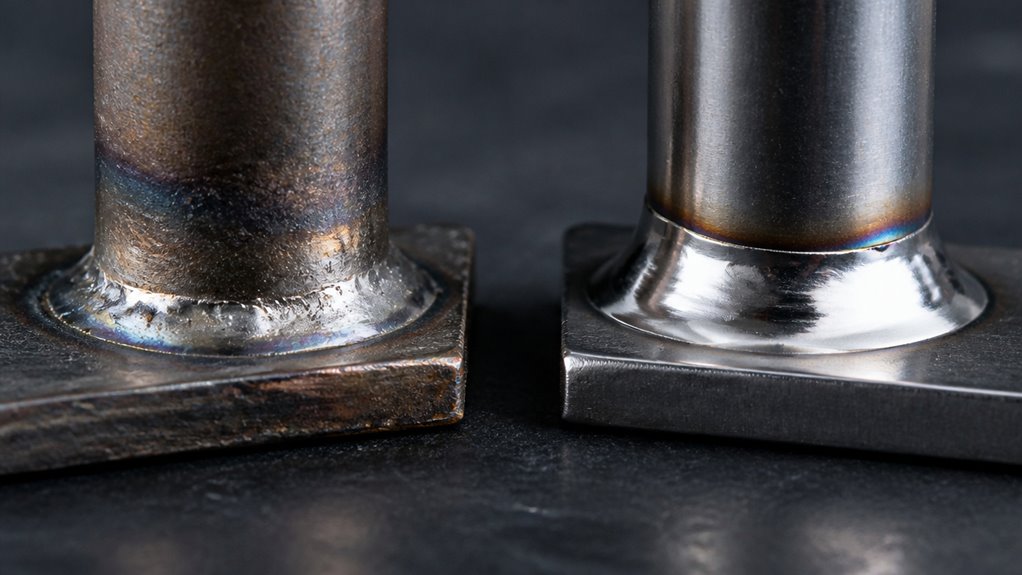
You’ll choose silver solder when working below 450°C, favoring ease of use and conductivity for light-duty or delicate jobs.
Silver brazing, done above 450°C with stronger, higher-silver alloys, creates joints nearly as strong as base metals.
This makes it ideal for structural or high-stress applications. Brazing demands precise fits, robust heat sources, and flux suited to higher temperatures.
Understanding these distinctions helps you match process, strength, and heat considerations to your project needs before exploring further details.

- 65% Silver Content(Easy)
- Length: 5 Feet
- Thickness:26 gauge(0.4 mm)

- Quality Material: our silver brazing rods are made from 15% silver and carefully selected elements…
- Large Quantity: this package includes 20 pcs welding rods, providing ample supply for multiple…
- Good Performance: Engineered with 15% silver, these rods deliver excellent wettability, higher joint…
Key Takeaways
- Silver solder melts below 450°C and suits light-duty, conductive joints, while silver brazing requires above 450°C for stronger, structural bonds.
- Silver brazing alloys contain 20%–60% silver, offering higher strength and durability compared to the lower silver content in silver solder alloys.
- Brazed joints approach base-metal strength and withstand vibration and pressure, unlike soldered joints which have lower mechanical integrity.
- Flux and heat sources differ: soldering uses low-temp flux and torches, brazing demands high-temp flux and robust heat like oxy-acetylene.
- Silver solder is ideal for electronics and delicate work; silver brazing suits plumbing, HVAC, and heavy-duty metal fabrication requiring long-lasting joints.
Silver Solder vs Silver Brazing: Key Differences in Temperature, Strength, and Applications
| Comparison Factors | Silver Soldering | Silver Brazing |
|---|---|---|
| Joining Process | Low-temperature metal joining using molten filler metal | Higher-temperature metal joining using silver-based brazing alloys |
| Temperature Classification | Filler metal melts below 450°C (842°F) | Filler metal melts above 450°C (842°F) |
| Typical Melting Range | Below 450°C, depending on alloy | Approximately 610–870°C, depending on alloy |
| Filler Metal Composition | Often tin-based alloys containing a small percentage of silver | Silver-copper-zinc alloys, sometimes containing nickel or other elements |
| Silver Content | Generally lower silver content | Article describes approximately 20–60% silver |
| Joint Strength | Lower mechanical strength, suitable for light-duty connections | Higher mechanical strength, suitable for demanding assemblies |
| Heat Requirements | Lower heat input with a soldering tool or small torch | Higher heat input using suitable brazing equipment |
| Flux Requirements | Low-temperature soldering flux | High-temperature brazing flux |
| Joint Formation | Molten filler wets and bonds metal surfaces | Molten filler flows through closely fitted joints by capillary action |
| Mechanical Stress Resistance | Better suited to low-load connections | Generally better suited to vibration, pressure, and mechanical loading |
| Thermal Impact | Less heat exposure to surrounding components | Greater heat exposure, requiring careful temperature control |
| Joint Preparation | Requires clean metal surfaces and suitable filler compatibility | Requires clean surfaces, controlled joint clearance, and proper heating |
| Common Applications | Electronics, delicate metalwork, jewelry, and light repairs | Plumbing, HVAC, metal fabrication, and structural assemblies |
| Best For | Delicate work and lower-temperature joining | Stronger joints and demanding service conditions |
| Overall Recommendation | Best when lower heat input and lighter-duty bonding are priorities | Best when mechanical strength and thermal durability are critical |
Key Differences Between Silver Solder and Silver Brazing

Although silver solder and silver brazing are often used interchangeably, the key difference lies in their operating temperatures and resulting joint characteristics.
Silver solder and silver brazing differ mainly in temperature and joint strength characteristics.
You’ll find silver solder melts below 450°C (842°F) and typically contains a small silver percentage, often tin-based.
In contrast, silver brazing involves filler metals melting above 450°C, with silver content ranging from 20% to 60%, combined with copper, zinc, or nickel.
This difference in composition and temperature affects joint strength and behavior. Silver brazing produces stronger, structural bonds via capillary action in tight joints, while silver solder suits light-duty applications prioritizing conductivity and ease of flow.
Additionally, industry terminology blurs these definitions. “Silver solder” sometimes refers to low-temperature solders or high-silver-content brazing alloys, requiring you to carefully assess specifications to distinguish them accurately.
For projects requiring precision and minimal damage to materials, using tools designed for clean, precise cuts similar to those in fiberglass applications can improve results and joint quality.
How Temperature Defines Silver Soldering vs Brazing?
The main difference between silver soldering and brazing really comes down to temperature. If the filler metal melts below 450°C (842°F), we’re talking about soldering. But once we hit that temperature or go above it, we’re in brazing territory. This distinction matters because it affects both the strength of the joint and how compatible the materials are. For repairs involving cast iron pipes exposed to high heat, selecting materials with appropriate temperature resistance is crucial to ensure durability and performance.
Temperature Threshold Differences
When you distinguish silver soldering from silver brazing, the critical factor lies in the operating temperature of the filler metal.
Silver soldering occurs below 450°C (842°F), employing alloys that melt at relatively low temperatures, often tin-based with minor silver content.
In contrast, silver brazing requires temperatures exceeding 450°C, frequently between 610°C and 870°C (1130°F to 1600°F), using higher-silver-content alloys.
This temperature threshold fundamentally defines the process classification.
Soldering involves filler metals liquefying at lower temperatures, ensuring minimal thermal impact on base metals.
Brazing demands elevated heat to activate alloys with enhanced mechanical strength.
Understanding this temperature boundary guides your selection of filler metals, fluxes, and heating methods.
This ensures optimal joint integrity and process efficiency tailored to your application’s thermal and structural requirements.
Melting Range Implications
The melting range of filler metals directly influences whether you classify a process as silver soldering or silver brazing. This temperature determines the alloy’s behavior and joint characteristics.
Silver solder melts below 450°C (842°F), enabling low-temperature joining with tin-based alloys containing minimal silver. Silver brazing requires temperatures above 450°C, often between 610°C and 870°C, using higher silver-content alloys for stronger, structural bonds.
Key implications include:
- Temperature defines flux choice and activation range.
- Higher melting points in brazing demand robust heat sources.
- Brazing filler metals exhibit superior mechanical strength.
- Soldering suits delicate, conductivity-focused applications.
- Melting range controls capillary action efficiency and joint integrity.
Understanding these parameters lets you optimize process selection for strength, joint quality, and thermal sensitivity.
Metals and Alloys in Silver Solder and Brazing
Understanding the specific metals and alloys used in silver solder and brazing is essential for selecting the right filler material for your application.
Silver solder typically contains tin as the base metal with a small silver percentage, enabling low melting points below 450°C.
In contrast, silver brazing alloys contain markedly higher silver content, ranging from 20% to 60%, combined primarily with copper and zinc, sometimes nickel or tin.
These compositions yield melting points well above 450°C, often between 610°C and 870°C.
The silver-copper eutectic alloy, for instance, melts near 780°C.
Zinc is sometimes excluded due to its potential to cause embrittlement or corrosion.
Understanding these alloy differences enables you to optimize joint performance, thermal compatibility, and mechanical strength according to your operational requirements.
Additionally, selecting materials resistant to corrosion is crucial to ensure the longevity and reliability of the joined components.
How Joint Strength Differs Between Silver Solder and Brazing?
You know, when it comes to silver brazing, you’ll notice that it usually creates stronger joints compared to silver soldering. This mainly stems from the higher melting temperatures and the specific composition of the filler metal.
But it’s not just about the method; the structural integrity of the joint really hinges on a few key factors. Things like how well the joint fits together, the penetration of the filler, and the kind of mechanical stresses at play all play a role. Additionally, materials with higher tensile strength and durability, like stainless steel, tend to produce more reliable joints under stress, contributing to overall mechanical strength.
Strength Comparison Overview
When comparing joint strength between silver solder and silver brazing, you’ll find that brazed joints typically exhibit markedly higher mechanical integrity.
Brazing’s elevated temperature and alloy composition create stronger metallurgical bonds, often approaching base-metal strength. In contrast, silver solder joints serve better for light-duty or conductive applications due to their lower strength and melting point.
Key distinctions include:
Brazed joints rely on capillary action for uniform filler distribution, enhancing strength.
Silver brazing alloys contain higher silver content, increasing tensile strength.
Solder joints have lower melting points, limiting load-bearing capacity.
Brazing fluxes withstand higher temperatures, ensuring joint quality.
Silver brazing suits applications with mechanical stress, vibration, or pressure.
Additionally, selecting materials and joining methods that can withstand high-temperature environments is crucial for ensuring long-term joint durability.
Understanding these factors helps you select the best joining method for strength-critical assemblies.
Structural Integrity Factors
The strength differences between silver solder and silver brazing stem largely from how each process influences the joint’s structural integrity.
When you use silver brazing, the higher temperature and silver-rich filler metal penetrate tight joints via capillary action. This produces a metallurgically strong bond that often approaches or exceeds the base metal’s strength.
In contrast, silver soldering relies on lower melting point alloys with less silver content. This yields joints that prioritize electrical conductivity or light-duty connections over mechanical strength.
Because silver solder filler metals are more fluid and less robust, their joints exhibit lower tensile strength and reduced resistance to mechanical stress.
Consequently, if structural integrity under load or vibration is your priority, silver brazing offers superior joint performance due to its stronger, more durable metallurgical bond.
For long-lasting repairs, it is essential to consider surface preparation to ensure proper bonding between materials and maximize joint strength.
Application-Based Strength Differences
Although both silver soldering and silver brazing create metal joints through filler metals, the resulting joint strength varies markedly depending on the application’s demands.
You’ll find silver brazing produces stronger, more durable joints, often nearing base-metal strength, due to higher melting temperatures and silver content.
Silver solder, melting below 450°C, suits light-duty or electrical applications where strength is secondary.
Consider these distinctions:
Brazing uses capillary action for tight, strong joints under mechanical stress.
Soldering offers fluid filler flow but weaker bonding, ideal for delicate parts.
Brazed joints resist vibration and pressure better than soldered ones.
Silver brazing requires higher heat and specialized fluxes for peak strength.
Solder joints prioritize conductivity and ease over structural performance.
Choose based on strength needs, thermal sensitivity, and joint fit precision.
The choice of joining method can also impact long-term reliability, much like how pump reliability varies with different pump designs and operating conditions.
Flux and Heat Requirements for Silver Solder vs Brazing
Since silver soldering and silver brazing operate at distinctly different temperature ranges, you’ll need fluxes specifically formulated for each process to guarantee proper joint formation.
Silver solder flux activates below 450°C (842°F), while brazing flux remains effective at temperatures up to 870°C (1600°F). Using low-temp flux for brazing risks premature consumption, compromising the joint.
Brazing demands higher heat sources like oxy-acetylene torches, whereas soldering requires less intense heating.
| Process | Flux Activation Temp | Heat Source Required |
|---|---|---|
| Silver Solder | Below 450°C (842°F) | Propane or small torch |
| Silver Brazing | 500–870°C (932–1600°F) | Oxy-acetylene or high-heat torch |
| Flux Consumption | Low at soldering temps | Sustained at brazing temps |
Selecting proper flux and heat guarantees joint integrity and process efficiency.
For applications involving mineral-rich environments, using corrosion-resistant materials like solid brass or stainless steel in joints can improve durability and performance.
Choosing Between Silver Solder and Silver Brazing for Your Project
Proper flux selection and heat management set the foundation for successful joining. Choosing between silver solder and silver brazing ultimately hinges on your project’s specific requirements.
You’ll need to analyze factors like mechanical strength, operating temperature, and joint fit. Consider these points:
Use silver solder for low-temperature applications and delicate components.
Opt for silver brazing when higher joint strength and durability are critical.
Assess base-metal sensitivity to heat; brazing demands higher temperatures.
Evaluate joint precision; brazing requires tightly fitted joints for capillary action.
Match flux type to your process temperature to guarantee proper activation.
Additionally, applying the right penetrating oil can help maintain valve components and prevent corrosion in assemblies involving metal joints.
Common Applications for Silver Solder and Silver Brazing
When selecting between silver solder and silver brazing, understanding their typical applications helps you align your choice with functional demands.
Use low-temperature silver solder for electronics, delicate components, jewelry, and light-duty repairs where conductivity and minimal thermal impact matter.
It suits joints that don’t require high mechanical strength.
Conversely, silver brazing excels in plumbing, HVAC, bicycle frames, and heavy-duty metal fabrication.
It offers superior joint strength and resistance to vibration and pressure.
Its higher melting range and strong structural bonds make it ideal when durability and thermal stability are critical.
You must also consider joint fit and base-metal sensitivity.
Brazing demands precise clearance and higher heat, while soldering tolerates looser fits and lower temperatures.
This guarantees peak performance and longevity in your assemblies.
For tasks requiring precise control and minimal damage, using appropriate tools is essential to ensure clean and reliable joints.
Frequently Asked Questions
Can Silver Solder or Brazing Be Used on Non-Metal Materials?
You generally can’t use silver solder or brazing on non-metal materials because both require metallic surfaces to form a strong metallurgical bond.
These processes depend on melting filler metal that wets and adheres to metal substrates via capillary action or surface tension.
If you try them on non-metals like plastics or ceramics, the filler won’t bond properly, leading to weak or failed joints.
You’ll need specialized adhesives or joining methods instead.
What Safety Precautions Are Needed When Silver Brazing?
When silver brazing, temperatures often reach above 700°C (1300°F).
You must wear heat-resistant gloves and eye protection to prevent burns and eye damage.
Ensure proper ventilation since flux fumes can be toxic.
Use a fire-resistant workspace and keep a fire extinguisher nearby.
Avoid inhaling fumes by working outdoors or with a fume extractor.
Always handle gases and torches carefully to prevent leaks and explosions during brazing operations.
How Does Silver Content Affect Corrosion Resistance?
You’ll find that higher silver content in alloys generally improves corrosion resistance because silver is less reactive and more noble than other metals like copper or zinc.
When you use a filler metal with increased silver percentages, it forms a more stable, less oxidizable surface, reducing corrosion risk.
However, the exact effect depends on the complete alloy composition and service environment. You should analyze specific conditions for peak corrosion performance.
Are There Environmental Concerns With Silver Solder or Brazing?
You should know that improper disposal of silver-containing alloys can contaminate water, impacting aquatic life.
Both silver solder and brazing involve fluxes that emit fumes; some flux components can release harmful gases if overheated.
Using correct flux and ventilation minimizes risks.
Additionally, silver mining has environmental costs, so recycling scrap material reduces impact.
Choosing alloys with less toxic additives and adhering to safety protocols helps protect the environment and your health.
Can Silver Brazing Be Automated in Manufacturing Processes?
Yes, you can automate silver brazing in manufacturing, especially for high-volume production.
Automated systems control precise heat application, filler metal feed, and fluxing, guaranteeing consistent joint quality.
You’ll benefit from reduced labor costs and improved repeatability.
However, you must guarantee tight joint tolerances and reliable fixturing since brazing relies on capillary action.
Automation suits industries like HVAC or bicycle frame assembly, where strong, consistent brazed joints are critical.
Silver Solder vs Silver Brazing: Making the Right Choice
You might think silver solder and silver brazing are just fancy names for the same thing, but they’re not.
While both join metals with silver alloys, their temperature ranges, strength, and flux demands differ sharply.
So, if you want a joint that’s either delicately precise or industrially robust, your choice matters.
Because in metalwork, “silver” doesn’t always mean “simple.” Ironically, picking the right method could be the most complex part of your project.
- 65% Silver Content(Easy)
- Length: 5 Feet
- Thickness:26 gauge(0.4 mm)
- Quality Material: our silver brazing rods are made from 15% silver and carefully selected elements…
- Large Quantity: this package includes 20 pcs welding rods, providing ample supply for multiple…
- Good Performance: Engineered with 15% silver, these rods deliver excellent wettability, higher joint…
Last update on 2026-10-24 / Affiliate links / Images from Amazon Product Advertising API