
To best dehumidify your basement, start by selecting an ENERGY STAR-rated dehumidifier sized for your space, typically 35–60 pints for medium basements. Place it centrally with clear airflow, near a drain or pump for continuous water removal. Aim for 40–50% humidity using an accurate hygrometer.
Maintain gutters and exterior grading to minimize moisture intrusion. Regularly clean filters and inspect drains. Combining these steps guarantees lasting dryness and mold prevention. Learn how to fine-tune and maintain your setup for peak results.
Key Takeaways
- Address exterior water issues by extending downspouts, regrading soil away from the foundation, and sealing foundation cracks to prevent moisture entry.
- Choose a dehumidifier sized to basement area and moisture level, preferably ENERGY STAR-certified with automatic humidistat and continuous drainage capability.
- Place the dehumidifier centrally on a stable surface with at least 12 inches clearance, near moisture sources and close to a drain or condensate pump.
- Maintain indoor relative humidity between 30–50%, using calibrated hygrometers away from vents and exhaust for accurate monitoring and adjustment.
- Use fans to improve air circulation, keep filters clean, and consider whole-house or low-temperature units for cool or heavily damp basements.
Understanding Basement Moisture Sources
When you’re tackling basement moisture, understanding its sources is essential because water can enter from multiple points and mechanisms. Exterior water is a major culprit. Rain runoff from your roof can deliver over 1,200 gallons per inch of rain.
If gutters, downspouts, or grading slope poorly, water pools against your foundation. Ineffective grading can worsen this problem by causing water to flow toward rather than away from the house. Installing a sump pump system can help remove excess water that accumulates near the foundation.
High groundwater or missing subsurface drains increase hydrostatic pressure, forcing water through cracks or porous concrete. Building envelope defects like wall or floor cracks, poorly sealed utility penetrations, and deteriorated waterproofing let water and humid air in.
Interior moisture also plays a role. Activities like cooking and laundry release humidity, plus damp stored items hold moisture. Air movement brings humid outdoor air inside, causing condensation on cold surfaces. Knowing these sources helps you target effective dehumidification strategies.
Types of Dehumidifiers Suitable for Basements
Although basements vary widely in temperature and moisture levels, choosing the right dehumidifier depends on these conditions and your space’s size. You have several effective options tailored to different needs:
Refrigerant dehumidifiers excel in moderate temps (65–80°F), ideal for medium to large basements. Models with automatic defrost help prevent coil icing in cooler areas. For larger spaces, units with higher dehumidification capacity are especially critical to effectively manage basement moisture.
Low-temperature refrigerant units maintain efficiency down to the upper 30s °F. They feature corrosion-resistant coils and built-in pumps for continuous drainage. Desiccant dehumidifiers work well below refrigerant limits, using sorbent material. They’re compact but consume more energy per pint.
Whole-house or HVAC-integrated systems provide balanced humidity control for finished basements and multi-level homes. However, they require professional installation. Selecting among these depends on your basement’s temperature range and moisture challenges.
Choosing the Right Dehumidifier Capacity

Determine the right dehumidifier capacity by matching it to your basement’s size and moisture level. Small basements (300–500 sq ft) with mild dampness need 20–30 pints/day, while moderate spaces (600–1,200 sq ft) require 35–60 pints/day. For large or very wet basements (1,500+ sq ft), choose 70–100+ pints/day.
Choosing the proper capacity is important because it prevents mold growth and protects your home’s structure. Regular maintenance ensures the dehumidifier operates at peak energy efficiency. Consider leaks, flooding history, and mustiness to adjust upward.
| Basement Size | Condition | Recommended Capacity (pints/day) |
|---|---|---|
| Small (300–500 sq ft) | Slightly damp | 20–30 |
| Medium (600–1,200 sq ft) | Moderate humidity | 35–60 |
| Large (1,500+ sq ft) | Wet or flooded | 70–100+ |
Ideal Placement for Basement Dehumidifiers
To get the most out of your basement dehumidifier, place it centrally in the largest open area to guarantee even airflow and consistent humidity control throughout the space.
Keep at least 12 inches of clearance from walls and objects to prevent restricted intake and exhaust. Position the unit near primary moisture sources like exterior walls or laundry areas to tackle high humidity pockets directly. Installing a battery backup system can help ensure your dehumidifier continues running during power failures.
Make certain the dehumidifier sits on a stable, dry surface, elevating it slightly if minor floor moisture occurs. Locate near a floor drain or condensate pump for effective water removal. Maintain clear access for maintenance tasks like filter cleaning and drain checks.
Because basements in humid climates like Georgia often see moisture levels nearly double recommended indoor levels, reducing humidity to around 50% can significantly reduce allergen levels and improve indoor air quality. Use fans to improve air circulation if the basement is large or obstructed. Avoid placing the unit in flood-prone or combustible zones to guarantee safety.
Setting and Maintaining Proper Humidity Levels
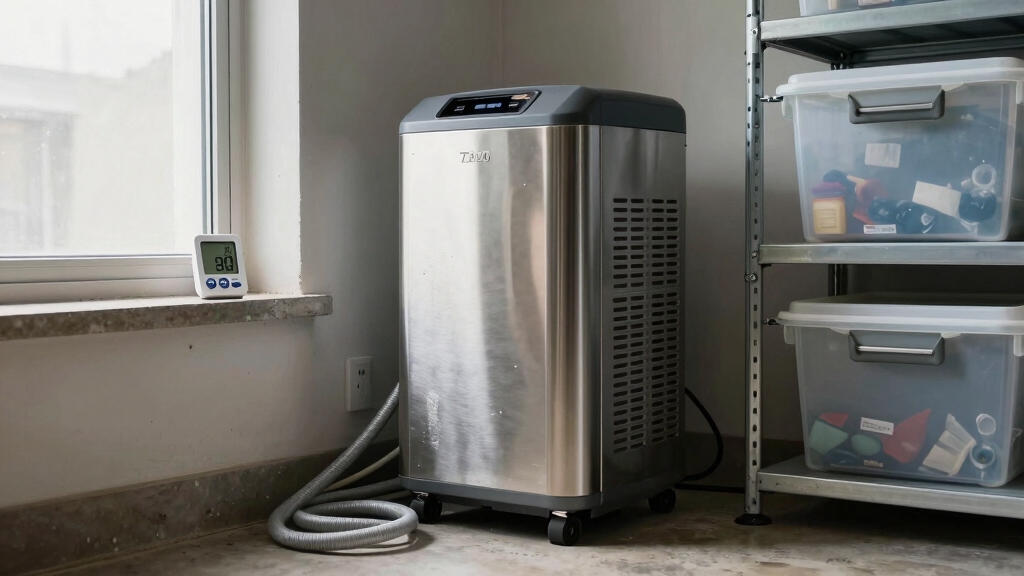
Properly setting and maintaining humidity levels in your basement helps prevent mold growth, wood damage, and pest problems. It is also crucial to identify and address the source of excess moisture to achieve effective humidity control. Using ventilation and heating solutions, such as a bath fan with heater, can aid in managing moisture levels effectively.
Aim for a relative humidity (RH) between 30–50%, with 40% as a stable midrange target. Use calibrated hygrometers placed away from vents and dehumidifier exhaust to monitor RH continuously, logging data to track trends.
In colder climates, target 20–25% to avoid condensation. Dehumidifiers with automatic humidistats and programmable setpoints keep RH within range, using hysteresis to prevent frequent cycling. Adjust setpoints seasonally: lower in humid months, slightly higher in winter to balance moisture control and avoid over-drying.
For large or partitioned basements, deploy multiple sensors to capture zone variations. Supplement sensor data with visual checks for condensation or musty odors, ensuring you address microclimates effectively and maintain a healthy basement environment.
Drainage Options for Continuous Operation
When you need your dehumidifier to run continuously without frequent emptying, choosing the right drainage option is essential. Selecting the proper drainage method is key for nonstop dehumidifier operation without frequent emptying.
You can rely on gravity drainage if a floor drain or lower elevation point is nearby. Just guarantee the hose slopes downward without elevation. This method is often preferred for its simplicity and energy efficiency compared to submersible sump pumps.
For basements without a convenient drain, pump-assisted drainage is your best bet. This allows condensate to be pumped vertically or horizontally up to 40 feet. Many models feature auto-purge pumps that empty automatically without manual resets, supporting nonstop operation.
Consider these factors for continuous drainage:
- Gravity drainage needs a properly sloped 12mm hose to a floor drain.
- Pump-assisted drainage handles up to 40-foot runs with auto-purge.
- Built-in sensors and timers maintain uninterrupted operation.
- Backup removable buckets prevent overflow during drainage issues.
- Choose a unit with a 2-liter water tank capacity to minimize bucket emptying when not using continuous drainage.
Complementary Measures to Reduce Basement Moisture
Although a dehumidifier plays a key role in controlling basement moisture, you’ll also need to tackle other sources to achieve lasting dryness. Start by inspecting plumbing for leaks and sealing sump basins to stop continuous water input.
Make certain dryer vents exhaust outdoors, and avoid indoor clothes drying or basement humidifiers. Improve ventilation by using exhaust fans and mechanical ventilation, creating airflow paths to prevent stagnant air.
Seal cracks and apply waterproof membranes on walls and floors, while insulating rim joists to reduce air leaks. Maintain gutters and downspouts, regrade soil to slope away from your foundation, and use gravel or swales to divert surface water.
These complementary steps reduce moisture at its source, supporting your dehumidifier’s effectiveness and preventing mold and structural damage. Additionally, regularly inspecting and maintaining your sump pump’s discharge line ensures proper water removal and helps prevent basement flooding.
Energy Efficiency and Operating Costs Considerations
When it comes to choosing a dehumidifier for your basement, you’ll want to make sure it’s the right size for the moisture load you’re dealing with. It’s all about striking a balance between capacity and runtime to make the most of your energy use. Proper installation and maintenance of corrosion-resistant materials can also improve the longevity and efficiency of your equipment.
If you opt for larger-capacity units, they tend to run less often and do so more efficiently—this is especially true in spaces that are consistently damp or cooler. In fact, 50-pint units provide the best efficiency-to-coverage ratio, making them an ideal choice for typical basement sizes.
Also, keep an eye out for models with high Integrated Energy Factor (IEF) ratings and that boast ENERGY STAR certification. These features can really help you cut down on operating costs while still getting the performance you need.
Energy-Efficient Unit Selection
Selecting an energy-efficient dehumidifier starts with understanding key performance metrics like energy factor, which measures how many liters of moisture the unit removes per kilowatt-hour consumed.
In our testing, models like the Honeywell 50-Pint demonstrated an excellent energy factor of around 2.07 L/kWh, reflecting strong efficiency. You’ll want a model that balances high moisture removal with low power use to minimize operating costs.
Consider these factors when choosing your unit:
- Look for ENERGY STAR certification to guarantee compliance with federal efficiency standards. Many energy-efficient units also feature quiet operation to reduce noise disruptions.
- Choose models with variable-speed fans or compressors to reduce power consumption near target humidity.
- Prioritize units with accurate auto-humidistat controls to avoid unnecessary runtime.
- Opt for continuous drainage options to prevent runtime interruptions and improve overall efficiency.
Balancing Capacity With Runtime
Balance your dehumidifier’s capacity carefully to match your basement’s moisture load, or you’ll either run it nearly nonstop or waste energy with an oversized unit.
Calculate moisture load using your basement’s area, current relative humidity, and typical outdoor humidity to estimate daily pints needed. Selecting equipment with a suitable flow rate is crucial for effective moisture removal.
Aim for steady-state operation where the unit cycles on and off, maintaining 40–50% RH, which uses less energy than constant high-output running. In basements with high humidity levels, continuous operation may be necessary to maintain a dryer environment.
Remember, rated capacity often drops in cooler basement air, so size for typical steady-state conditions, not extreme peaks. Use timers or smart controls to run the unit during high-humidity or off-peak hours, and set your humidistat to the highest acceptable RH to reduce runtime.
Regular Maintenance and Monitoring Tips
Regularly maintaining and monitoring your basement dehumidifier guarantees it operates efficiently and extends its lifespan. You should clean or wash reusable air filters every 2–4 weeks during heavy use to maintain airflow and efficiency.
Keep your basement dehumidifier efficient by cleaning filters every 2–4 weeks during heavy use. Empty and sanitize the condensate bucket at least weekly to prevent microbial growth.
Check that the drain hose is properly routed and sloped for continuous drainage. Use a hygrometer weekly to verify the basement’s humidity stays between 45–50%. Ensure the unit is placed on a level, steady surface to prevent vibrations and mechanical issues. Selecting a dehumidifier with a quiet operation feature can also improve comfort during use.
Inspect evaporator and condenser coils annually, removing dust with a vacuum or soft brush. Monitor power and runtime monthly to detect abnormal operation. Check condensate lines for leaks and clear as needed. Test float switches and pumps quarterly to avoid flooding.
When to Seek Professional Assistance?
If you notice persistent high humidity, visible mold, or extensive water damage in your basement, it’s time to call in a professional.
DIY dehumidifiers often can’t handle saturated materials or hidden moisture behind walls and floors. Certified technicians use commercial-grade equipment to extract water and control humidity precisely.
When relative humidity stays above 60% despite your efforts, or mold appears, delaying professional help risks structural damage and health hazards. Lingering moisture can cause wood warping, drywall swelling, and weakened ceilings if left untreated.
Also, underlying issues like foundation leaks or ventilation problems require expert diagnosis and customized solutions. Professionals follow a thorough process: inspection, extraction, drying, and may recommend installing whole-house systems for long-term control.
Don’t wait; licensed experts provide warranties and ensure efficient, safe moisture removal to protect your basement and your health.
Frequently Asked Questions
Can Houseplants Help Reduce Basement Humidity Effectively?
Houseplants alone won’t effectively reduce basement humidity.
While plants like Boston Ferns and English Ivy absorb some moisture, they thrive in already humid environments.
They can even increase humidity through transpiration.
You’ll need a mechanical dehumidifier to control basement moisture reliably.
However, placing moisture-loving plants in damp areas can complement dehumidifiers by improving air quality slightly.
But don’t rely on them as your primary solution for basement humidity control.
Is It Safe to Use a Basement Dehumidifier Near Electrical Panels?
You might think placing a dehumidifier near your electrical panel is convenient, but it’s risky.
Condensation and leaks can cause corrosion, short circuits, or breaker failures.
Always position the dehumidifier so drain lines direct water away, use a dedicated circuit, and maintain clearance around the panel.
Elevate the unit if needed, avoid extension cords, and install GFCI outlets.
Safety first; never compromise electrical integrity for convenience.
How Does Basement Ceiling Insulation Affect Dehumidifier Performance?
Basement ceiling insulation raises air temperature by reducing heat loss, which typically lowers relative humidity and can reduce your dehumidifier’s runtime.
However, if you don’t air seal properly, warm moist air might get trapped against cold surfaces, making your dehumidifier work harder.
Also, insulation can change airflow patterns, so you’ll need to place sensors carefully and possibly improve circulation to avoid high-humidity pockets and optimize dehumidifier efficiency.
Can a Basement Dehumidifier Help Reduce Radon Levels?
Think of a basement dehumidifier as a gatekeeper, drying the air to close cracks where radon sneaks in.
While it doesn’t remove radon gas directly, lowering humidity reduces radon’s entry through porous surfaces.
Using a powerful, professional-grade unit like SaniDry enhances this effect, boosting air quality and HVAC efficiency.
For best results, combine dehumidifiers with soil depressurization systems and vapor barriers to tackle radon and moisture at their source effectively.
Are There Smart Dehumidifiers With App Controls for Basements?
Yes, you can find smart dehumidifiers with app controls specifically designed for basements.
Brands like AlorAir, Honeywell, and Midea offer models that connect via Wi-Fi, letting you monitor humidity, adjust settings remotely, and get maintenance alerts right from your phone.
Some commercial-grade units include built-in pumps and advanced sensors, giving you precise control and efficient moisture removal tailored to basement conditions.
Stop Treating Symptoms: Fix Basement Moisture Right
You might think simply running a dehumidifier solves all basement moisture issues, but it’s not that simple. True, a properly sized dehumidifier placed in the right spot and set to maintain 50% humidity works best.
Still, addressing moisture sources and using complementary measures like sealing cracks are vital. Don’t overlook regular maintenance to keep your system efficient. If problems persist, seeking professional help guarantees you tackle the root cause, not just the symptoms.