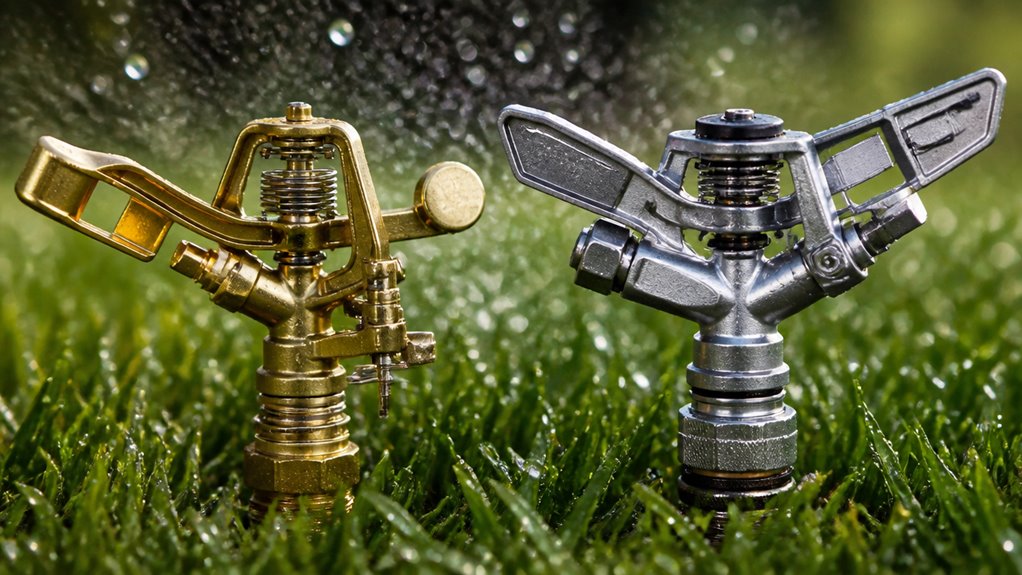
You’ll get precise, consistent rotation and higher distribution uniformity with gear drive sprinklers. Their internal gears maintain steady speeds despite pressure changes.
They run 20–35% lower flow rates, improving water efficiency and reducing runoff. Impact sprinklers cover larger areas using kinetic energy but deliver variable rotation speeds.
This results in less uniform streams, especially under fluctuating pressure. They require more upkeep and produce more noise.
Exploring their operational differences reveals why one might suit your application better.
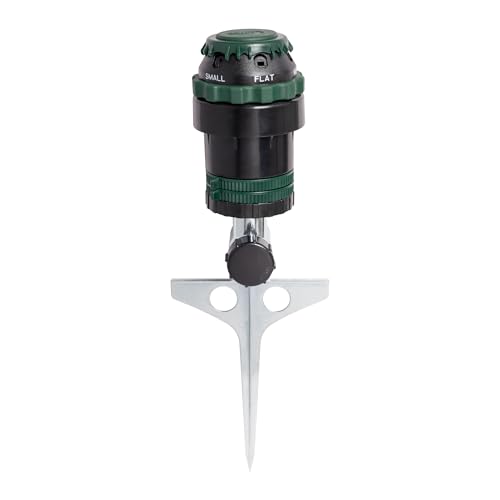
- Lush Lawn Coverage: The Orbit H2O-Six Gear Drive Sprinkler delivers efficient watering for lawns and…
- Effortless Spray Adjustments: Customize watering angles and spray distance with rotating head…
- Precise Water Distribution: Built with a four-position spray control system that helps fine-tune…


- New color, upgrade brass nozzle, 8.86 x 7.87 x 5.12 inches.
- Heavy-duty Anti-tip Metal Base: Crafted from high-grade zinc alloy, both the impact head and…
- Easy To Use: Simply attach your garden hose to the lawn sprinkler hose connector supplied and turn…
Key Takeaways
- Gear drive sprinklers use internal gears for consistent 1–3 RPM rotation, ensuring uniform water distribution regardless of pressure changes.
- Impact sprinklers rely on water kinetic energy hitting a spring arm, causing variable rotation speeds and uneven coverage under fluctuating pressure.
- Gear drives operate at 20–35% lower flow rates, reducing runoff, evaporation, and enhancing water efficiency compared to impact sprinklers.
- Distribution Uniformity with gear drives exceeds 85%, outperforming impact sprinklers’ 70–78%, resulting in more precise and efficient irrigation.
- Impact sprinklers cover larger areas (up to 150 ft), while gear drives suit smaller, noise-sensitive landscapes with quieter, precise operation.
Gear Drive vs Impact Sprinkler Comparison: Water Efficiency, Coverage, Noise, and Maintenance
| Comparison Point | Gear Drive Sprinkler | Impact Sprinkler | Best Choice |
|---|---|---|---|
| Operating Mechanism | Uses internal gears for smooth, steady rotation | Uses water force to move a spring-loaded impact arm | Gear drive for controlled rotation |
| Rotation Stability | Maintains consistent 1–3 RPM rotation | Rotation speed changes with water pressure | Gear drive for steady coverage |
| Water Pressure Response | Handles pressure changes more consistently | More sensitive to pressure fluctuations | Gear drive for variable pressure |
| Water Efficiency | Uses 20–35% lower flow rates for similar coverage | Often needs higher flow to drive the arm | Gear drive for water savings |
| Distribution Uniformity | Often reaches above 85% uniformity | Usually around 70–78% uniformity | Gear drive for even watering |
| Coverage Radius | Better for smaller zones, usually up to 55 ft | Can cover larger areas, up to 150 ft | Impact for large open spaces |
| Noise Level | Runs quietly with smooth gear movement | Produces clicking from the impact arm | Gear drive for quiet areas |
| Maintenance Needs | Needs seasonal maintenance with cleaner water | Needs more frequent maintenance every 2–3 months | Gear drive for lower upkeep |
| Dirty Water Tolerance | Less tolerant of sediment and debris | Handles dirty water better | Impact for rough water sources |
| Best Application | Residential lawns, gardens, and precise irrigation zones | Fields, parks, large lawns, and rugged spaces | Depends on site conditions |
Operational Mechanisms of Gear Drive vs Impact Sprinklers

Understanding the operational mechanisms behind gear drive and impact sprinklers is essential for selecting the right irrigation system. You’ll find gear drives employ internal gears that rotate sprinkler heads steadily at 1–3 RPM. This ensures continuous, coherent water streams.
This mechanical precision offers consistent rotation speed, independent of pressure changes. In contrast, impact sprinklers harness kinetic energy from water hitting a spring-loaded arm. This produces circular motion through intermittent impacts.
Their water stream fragments into droplets during rotation, resulting in less uniform coverage. While gear drives enable smooth, controlled water distribution, impact sprinklers rely on mechanical force generated by water flow. This causes variable rotation speeds and fragmented spray patterns.
Similar to how spring-loaded mechanisms in quiet sump pump check valves control closing speed to reduce noise, the spring-loaded arm in impact sprinklers governs rotation through intermittent impacts.
Water Pressure Effects on Gear Drive vs Impact Sprinklers
You’ll notice that gear drive sprinklers have this cool ability to keep their rotation speeds steady, no matter how the water pressure changes. This is thanks to their internal gear mechanisms. Pretty neat, right?
In contrast, impact sprinklers don’t have that same consistency. Their rotation speed and flow rates can really fluctuate based on the pressure. This variation can lead to uneven coverage, which is something you definitely want to avoid.
Maintaining consistent performance under varying conditions is similar to how self-leveling tools use internal sensors to ensure reliability.
Rotation Speed Stability
Typically, gear drive sprinklers maintain a consistent rotation speed between 1 and 3 RPM regardless of fluctuations in water pressure. This is thanks to their internal gear mechanisms.
This design guarantees steady rotation, providing uniform coverage and precise irrigation control. In contrast, impact sprinklers rely on the kinetic energy from water pressure to strike a spring-loaded arm, causing variable rotation speeds as pressure changes.
When water pressure drops, the impact arm slows down, disrupting the sprinkler’s arc timing and potentially causing uneven water distribution. Conversely, high pressure can accelerate the arm, leading to faster rotation and inconsistent coverage.
Understanding this difference helps you select the right sprinkler type for your system’s pressure stability needs. Gear drives offer reliable rotation speed stability, while impact sprinklers may fluctuate with pressure variations. Pumps with adjustable flow rates can help maintain consistent water pressure to optimize sprinkler performance.
Flow Rate Variations
While gear drive sprinklers maintain consistent rotation speeds despite pressure changes, their flow rates respond differently compared to impact sprinklers.
You’ll notice that gear drives operate at lower flow rates because their internal gears don’t rely on water force for rotation. In contrast, impact sprinklers need higher flow rates to generate the kinetic energy necessary to move their weighted arms.
Consider these key differences:
Gear drives run 20–35% lower flow rates for the same coverage radius.
Impact sprinklers increase flow to maintain arm movement under varying pressures.
Lower flow rates in gear drives reduce runoff and allow better soil absorption.
Higher flow rates in impact systems can lead to uneven coverage and elevated evaporation.
Understanding these dynamics helps you optimize irrigation efficiency based on system choice.
Additionally, choosing the appropriate flow rate can significantly impact water conservation and overall system performance.
Water Pressure Sensitivity
Frequently, water pressure plays a critical role in determining sprinkler performance, but gear drive and impact sprinklers respond very differently to its fluctuations.
Gear drive sprinklers utilize internal gearing to maintain a consistent rotation speed of 1–3 RPM, regardless of pressure changes. This mechanical regulation guarantees uniform water distribution and steady precipitation rates even under variable pressure.
In contrast, impact sprinklers depend on water’s kinetic energy to move the weighted arm. When pressure dips, rotation slows, disrupting arc timing and causing uneven coverage. Higher pressure boosts impact arm speed but may increase precipitation rates beyond ideal soil absorption.
Consequently, if your water pressure fluctuates, gear drives offer more reliable performance and uniformity. Impact sprinklers’ coverage and efficiency degrade as pressure varies. This difference critically affects irrigation precision and water conservation.
Additionally, impact sprinklers typically require a higher operating pressure range (25–80 PSI) compared to gear drive rotors, which generally operate effectively up to 60 PSI, influencing their suitability for different irrigation systems and pressure conditions operating pressure range.
Distribution Uniformity: Gear Drive vs Impact Sprinklers
You’ll notice that gear drive sprinklers really shine when it comes to distribution uniformity. They often achieve rates above 85%. In contrast, impact sprinklers usually fall between 70% and 78%. That’s quite a difference!
What does that mean for you? Well, it translates to about 12–15% more water being delivered efficiently to the root zone. That can lead to significant savings in your water usage.
Plus, if you look at professional standards, like those from the Sports Turf Managers Association, gear drive performance is set as the benchmark for ideal irrigation uniformity. So, when you choose gear drive sprinklers, you’re not just getting better performance—you’re aligning with industry best practices!
Uniformity Rate Comparison
Because uniform water distribution directly impacts irrigation efficiency, comparing the Distribution Uniformity (DU) of gear drive and impact sprinklers is essential.
Gear drives consistently deliver DU rates above 85%, while impact sprinklers typically range between 70% and 78%. This difference affects how evenly water reaches the root zone, influencing plant health and water use.
Consider these key points:
Gear drives maintain steady rotation speeds, ensuring coherent water streams and precise coverage.
Impact sprinklers’ fragmented streams cause uneven distribution, lowering DU values.
Higher DU in gear systems reduces water waste by minimizing over- and under-irrigated areas.
The 12–15% DU gap translates directly into improved irrigation efficiency and uniform soil moisture.
Understanding these differences helps you select the appropriate sprinkler for optimal water consistency.
Additionally, selecting irrigation equipment with energy-efficient designs can further optimize resource use and performance.
Water Savings Impact
Significant water savings stem from the higher Distribution Uniformity (DU) rates achieved by gear drive sprinklers compared to impact models. Gear drives consistently deliver DU rates above 85%, while impact sprinklers hover between 70% and 78%.
This 12–15% difference directly translates to more efficient water application at the root zone, reducing waste and runoff. Additionally, gear drive systems operate at 20–35% lower flow rates for the same coverage, allowing soil better absorption and minimizing evaporation losses.
Their coherent water stream reduces wind drift by 8–12%, further enhancing efficiency. By contrast, impact sprinklers’ fragmented streams and higher precipitation rates increase uneven coverage and water loss.
Choosing gear drive sprinklers guarantees you apply water more uniformly and economically, optimizing irrigation performance while conserving water resources. Moreover, selecting equipment with better energy efficiency contributes to lowering overall operational costs.
Professional Standards Compliance
While both gear drive and impact sprinklers fulfill irrigation needs, gear drive systems consistently meet the stringent Distribution Uniformity (DU) standards set by professional organizations like the Sports Turf Managers Association.
You’ll find gear drives achieving DU rates above 85%, markedly outperforming impact sprinklers, which generally fall between 70% and 78%. This difference directly influences water efficiency and turf health.
Consider these critical compliance factors:
Gear drives maintain precise rotation speed via internal gears, ensuring uniform water distribution.
Impact sprinklers’ mechanical arm causes fragmented water streams, reducing DU.
Professional standards specify gear drive performance as ideal for sports turf and professional fields.
The higher DU of gear drives translates to measurable water savings and consistent irrigation quality.
Choosing gear drive systems aligns your irrigation with professional benchmarks for superior performance.
Additionally, selecting equipment with an appropriate activating sensor ensures reliable operation and energy efficiency in irrigation systems.
Water Efficiency: Gear Drive vs Impact Sprinklers
When evaluating water efficiency between gear drive and impact sprinklers, you’ll notice gear drives operate at flow rates 20–35% lower than impact sprinklers for the same coverage radius.
This reduced flow rate stems from gear drives’ internal gears rotating sprinkler heads at a consistent 1–3 RPM without requiring high water pressure.
Consequently, gear-driven systems deliver slower, coherent water streams that improve soil absorption and minimize runoff.
Impact sprinklers demand higher flow to move the spring-loaded arm, causing fragmented streams with increased evaporation and uneven coverage.
The precise rotation speed control in gear drives achieves Distribution Uniformity rates above 85%, outperforming impact sprinklers’ 70–78%.
This difference translates into significant water savings, especially over large irrigation cycles, making gear drives a technically superior choice for water-efficient irrigation.
Proper maintenance including disassembling components periodically ensures optimal sprinkler performance and longevity.
Coverage Radius and Suitability of Gear Drive vs Impact Sprinklers
Typically, impact sprinklers cover a broader radius than gear drives, ranging from 20 to 150 feet compared to gear-driven rotors’ 18 to 55 feet. This difference directly influences their suitability for specific applications.
Impact sprinklers excel in large, open spaces, allowing multiple streams to overlay and cover extensive zones efficiently. Conversely, gear drives suit smaller, noise-sensitive areas like residential lawns or landscaped gardens due to their quieter operation and precise rotation.
Consider these factors when choosing:
- Impact sprinklers adapt to large parks or unlandscaped fields with wide coverage needs.
- Gear drives optimize water distribution in confined or detailed landscapes.
- Gear-driven systems maintain consistent, quieter operation for residential settings.
- Impact heads support flexible arc adjustments over vast, irregular areas.
These distinctions guide your irrigation strategy based on spatial and operational demands. Additionally, the energy efficiency of gear drive sprinklers often makes them preferable for residential and small-scale applications.
Maintenance Differences Between Gear Drive and Impact Sprinklers
Choosing between gear drive and impact sprinklers involves more than coverage and noise considerations; maintenance requirements play a key role in system longevity and performance.
Gear drives demand seasonal maintenance under clean water conditions, benefiting from their sealed internal gears that reduce wear and clogging risk.
Conversely, impact sprinklers require more frequent upkeep every 2–3 months due to mechanical wear on the spring-loaded arm and exposure to sediment and debris.
While impact models tolerate dirty water better, their moving parts face accelerated degradation.
Gear drives, although less tolerant of sediment, maintain efficiency when properly maintained, minimizing downtime.
Understanding these differences helps you optimize irrigation reliability and reduce operational costs by aligning maintenance schedules with system design and water quality.
Noise and Environmental Suitability of Gear Drive and Impact Sprinklers
Frequently overlooked in irrigation system selection, noise levels and environmental compatibility greatly impact both user experience and site suitability. When choosing between gear drive and impact sprinklers, you need to take into account their distinct noise profiles and tolerance to environmental conditions.
Gear drive sprinklers operate quietly due to smooth internal gearing. This makes them ideal for residential or noise-sensitive areas.
Impact sprinklers generate audible clicking sounds from the spring-loaded arm. These sounds may be disruptive in quiet environments.
Gear drive mechanisms perform best in clean water, with reduced clogging risk. This ensures consistent operation.
Impact sprinklers tolerate sediment and debris better, making them suitable for less controlled water sources.
Understanding these factors helps you select the sprinkler that aligns with your environmental constraints and noise sensitivity requirements.
Controlling Precipitation Rates in Gear Drive and Impact Sprinklers
When managing irrigation efficiency, controlling precipitation rates is critical to match water application with soil absorption capacity.
Gear drive sprinklers deliver precipitation rates between 0.2 and 0.8 inches per hour. This allows you to fine-tune water depth precisely by adjusting pressure and nozzle size.
Gear drive sprinklers enable precise water depth control through adjustable pressure and nozzle sizes.
This control minimizes runoff and over-watering, optimizing soil infiltration.
In contrast, impact sprinklers produce a broader range—from 0.1 up to 1.5 inches per hour—but their coarse adjustment limits precise calibration.
High precipitation rates in impact systems can exceed the soil’s absorption rate, causing pooling and inefficient water use.
You’ll find gear rotors provide more consistent application, preventing excess water accumulation.
Consequently, for precise precipitation management aligned with soil characteristics, gear drive sprinklers offer superior control compared to impact models.
Choosing Between Gear Drive and Impact Sprinklers for Your Lawn or Field
Evaluate your specific irrigation needs by considering factors such as coverage area, water pressure stability, maintenance capacity, and desired water efficiency.
Gear drive sprinklers deliver precise rotation speeds, superior distribution uniformity, and lower flow rates.
They’re ideal for residential lawns or landscapes requiring quiet, water-efficient operation.
Impact sprinklers suit large, open fields with variable pressure and higher sediment tolerance but demand frequent maintenance.
Consider these points for your choice:
- Coverage: Impact heads cover broader areas (up to 150 ft). Gear drives serve smaller zones (up to 55 ft).
- Water Efficiency: Gear drives reduce flow by 20–35%, minimizing runoff and evaporation.
- Maintenance: Gear systems require seasonal upkeep. Impact arms need more frequent attention.
- Application Control: Gear drives offer fine-tuned precipitation rates, preventing overwatering and pooling.
Frequently Asked Questions
Can Gear Drive Sprinklers Be Retrofitted Onto Existing Impact Sprinkler Systems?
You generally can’t directly retrofit gear drive sprinklers onto existing impact sprinkler systems due to fundamental mechanical differences.
Impact sprinklers use a spring-loaded arm driven by water force, while gear drives rely on internal gears rotating at a precise speed.
Their mounting connections, flow requirements, and rotation mechanisms differ, so retrofitting would require replacing the entire sprinkler head and possibly adjusting the piping or pressure settings to guarantee proper operation.
What Is the Typical Lifespan of Gear Drive Versus Impact Sprinklers?
You can expect gear drive sprinklers to last about one irrigation season before maintenance, assuming clean water use.
Impact sprinklers need servicing every 2–3 months due to mechanical wear on their arms.
Impact sprinklers generally endure harsher environments better, handling sediment and debris with less damage.
Are There Specific Brands Known for Superior Gear Drive Sprinkler Durability?
You’ll find brands like Rain Bird and Hunter stand out for gear drive sprinkler durability.
They boast maintenance intervals of once per season in clean water, compared to the more frequent 2–3 months for impact sprinklers.
Rain Bird’s gear mechanisms resist clogging effectively, maintaining precise rotation speeds despite pressure fluctuations.
Their engineering guarantees over 85% distribution uniformity, which enhances efficiency and extends operational lifespan under typical landscaping conditions.
How Do Seasonal Weather Changes Affect Gear Drive and Impact Sprinkler Performance?
Seasonal weather changes impact your gear drive and impact sprinklers differently.
Cold temperatures can stiffen gear lubricants, slowing gear drive rotation.
Impact sprinklers’ spring arms may lose tension or freeze.
During windy seasons, gear drives maintain efficiency better due to coherent streams, reducing drift.
Conversely, heavy sediment in rainy seasons clogs gear mechanisms more, demanding frequent maintenance.
Impact sprinklers tolerate debris better but require arm adjustments to maintain consistent performance.
Do Gear Drive Sprinklers Require Specialized Tools for Installation or Repair?
You won’t need a treasure chest of specialized tools to install or repair gear drive sprinklers.
Most tasks require common hand tools like screwdrivers, wrenches, and pliers.
Their internal gears are designed for straightforward maintenance, usually done once per season, making your job less of a puzzle.
However, precision alignment and gentle handling help preserve the gear mechanism’s longevity and performance.
Approach repairs with care and patience.
Choose the Right Sprinkler for Your Lawn or Field
When choosing between gear drive and impact sprinklers, consider that gear drive sprinklers can operate quietly at over 50% less noise than impact models. This makes them ideal for noise-sensitive areas.
Their precise water distribution and efficiency often translate to better resource management. If you want a reliable, low-maintenance system with consistent coverage, gear drive sprinklers provide a technically superior option.
Impact sprinklers still suit rugged, high-pressure environments. Your choice should align with your specific irrigation needs and site conditions.

- Lush Lawn Coverage: The Orbit H2O-Six Gear Drive Sprinkler delivers efficient watering for lawns and…
- Effortless Spray Adjustments: Customize watering angles and spray distance with rotating head…
- Precise Water Distribution: Built with a four-position spray control system that helps fine-tune…
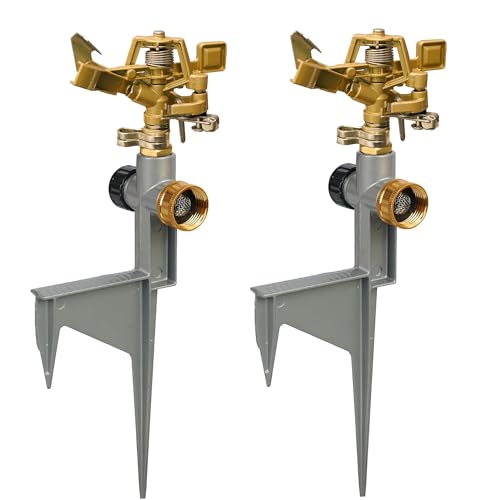
- Package Includes: Integrated water sprinklers, the size is 13.8 inch in length and can be inserted…
- High Quality: Constructed from high-quality zinc alloy and stainless steel, the garden sprinkler…
- Easy to Use: Our lawn sprinklers offer a adjustable spray pattern ranging from 0 to 360 degrees…
Last update on 2026-08-29 / Affiliate links / Images from Amazon Product Advertising API