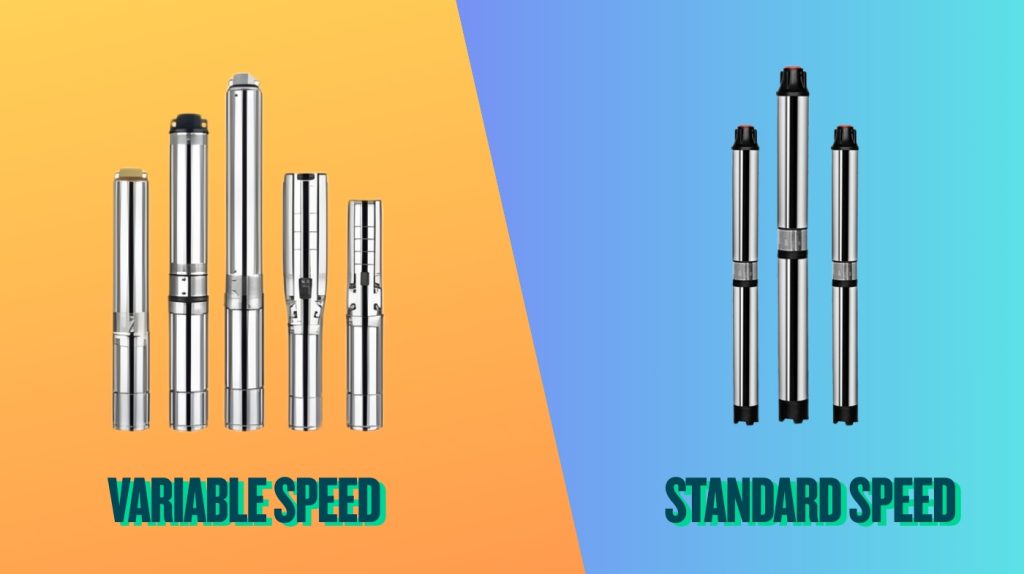
Choosing a variable-speed well pump over a standard fixed-speed model means you get consistent pressure with minimal surges. This can save 25–50% energy by matching motor speed to demand. You’ll extend pump life through reduced cycling and built-in diagnostics that prevent damage.
Although variable speed pumps cost more initially and need precise installation, their efficiency and longevity cut operating expenses and maintenance. If you want to optimize system performance and understand key trade-offs, keep exploring these comparisons.
Key Takeaways
- Variable speed well pumps maintain consistent pressure and flow, preventing drops during multiple fixture use, unlike standard fixed-speed pumps.
- They consume 25–50% less energy by adjusting motor speed to demand, resulting in significant cost savings over time.
- Variable speed pumps have longer lifespans (over 25 years) with built-in diagnostics and protection features, extending maintenance intervals.
- Installation requires proper space, ventilation, and NEC-compliant wiring, with programmable controls allowing customized operation and efficient system management.
- Advanced variable speed pumps offer smart monitoring, remote control, and predictive maintenance, aligning with rising energy standards and consumer preferences.
Side-by-Side Comparison Between Variable Speed Well Pump & Standard
| Feature | Variable Speed Well Pump | Standard Well Pump |
|---|---|---|
| Pressure Consistency | Maintains near-constant pressure | Pressure fluctuates during use |
| Energy Efficiency | Uses 25–50% less energy by adjusting speed | Runs at full speed every cycle |
| Pump Lifespan | Longer lifespan due to reduced cycling | Shorter lifespan from frequent on/off |
| Operating Noise | Quieter operation with soft start/stop | Louder starts and stops |
| Upfront Cost | Higher initial investment | Lower initial cost |
| Best For | Homes with variable or high water demand | Homes with basic, steady usage |
Understanding Constant Pressure Benefits
Although water demand fluctuates throughout the day, a variable speed well pump maintains consistent pressure within a narrow range, typically 30–60 PSI. This ensures steady flow regardless of simultaneous fixture use. Proper installation, including secure hose connections, is essential for optimal pump performance.
Variable speed well pumps keep water pressure steady, ensuring reliable flow even with multiple fixtures running.
You’ll notice it eliminates pressure drops common with multiple fixtures running, preventing weak faucet flow and unreliable showers. This prevents disruptions such as hot showers turning cold due to inadequate water flow.
By adjusting pump speed dynamically, it operates only at the necessary RPM, reducing mechanical stress and minimizing frequent on/off cycling.
This approach extends both pump lifespan and plumbing fixture durability by reducing wear and pressure-related damage. Consistent pressure also protects your appliances and plumbing seals from the stress caused by fluctuations, lowering maintenance needs.
Ultimately, this precise control delivers reliable water flow, enhances system longevity, and safeguards your household’s plumbing infrastructure with minimal operational strain.
Energy Efficiency Comparison
Did you know that variable speed well pumps can use about 25-35% less energy compared to fixed-speed models? It’s pretty impressive!
By adjusting the motor speed to match the actual water demand, these pumps really optimize energy use. This helps avoid issues like power surges that can damage standard pump components.
This energy savings not only helps you save on electricity bills, but it also means less wear and tear on the pump itself. So, in the long run, you’re looking at lower operating costs.
When you take a closer look at these efficiency gains, you can really see how they help you find the right balance between the initial investment and those long-term savings. It’s definitely worth considering!
Plus, variable speed pumps tend to last over 25 years, which is significantly longer than conventional pumps, reducing maintenance frequency and costs.
Energy Consumption Differences
How do variable speed well pumps achieve significant energy savings compared to standard pumps? By adjusting motor speed in real time via variable frequency drives (VFDs), they match output precisely to demand, avoiding wasteful full-speed operation typical of standard pumps.
This approach not only reduces energy consumption but also extends system lifespan by minimizing wear and tear on pump components. Proper maintenance, including addressing issues like mineral scale buildup, further enhances pump efficiency and longevity.
This results in energy reductions of 25–35%, sometimes reaching 50% under fluctuating demand.
| Pump Type | Energy Use Behavior | Typical Savings |
|---|---|---|
| Variable Speed Pump | Modulates speed with demand | 25–35% reduction |
| Standard Pump | Constant full-speed | Baseline consumption |
| Pool Variable Speed | High variability adaptation | Up to 60% savings |
| Systems w/ Constant Demand | Less impact | ~10% savings |
| Systems w/ Variable Demand | Maximized savings | Up to 50% |
Operating Cost Benefits
What drives the considerable operating cost benefits of variable speed well pumps? Primarily, their ability to modulate motor speed according to real-time water demand reduces electricity consumption by 20-50% compared to standard pumps.
Operating at partial speeds, such as 85%, cuts energy use to roughly 61.4% of full power, yielding nearly 39% cost savings. This adaptive control eliminates wasteful full-speed operation during low demand, optimizing energy efficiency and lowering utility expenses, especially under tiered or peak pricing.
Variable speed pumps also maintain steady water pressure, which reduces strain on system components and extends equipment lifespan system durability. Installing these pumps on a dedicated circuit further ensures reliable performance by preventing power fluctuations.
Additionally, soft-start features reduce mechanical stress and maintenance frequency, further decreasing lifecycle costs. These pumps’ energy savings typically translate into a 3-5 year payback despite higher upfront costs.
Impact on Operating Costs
Because variable speed well pumps adjust motor speed to match water demand, they considerably reduce energy consumption compared to single-speed pumps that run at full power regardless of usage. Proper disassembly procedures can help maintain these pumps’ efficiency over time.
You’ll see energy reductions of 70–100% under partial load conditions, with variable speed pumps operating around 132–140 watts versus 500–2,500 watts for standard submersible models.
This translates into monthly operating costs as low as $38–$40, compared to an average $65 for standard pumps, depending on motor size and electricity rates. Over an 84-month cycle, you could save $4,000–$4,300, with payback periods of 3–7 years.
These savings maximize in homes with variable water demand, where variable speed pumps maintain high efficiency across flow ranges, unlike standard pumps that waste energy at partial loads. Additionally, variable speed pumps can adjust their output to provide just the right flow rate, improving operational efficiency and reducing wear on the system.
Pump Longevity and Maintenance Needs
Did you know that variable speed pumps wear down differently compared to traditional pumps? It’s mainly because of their complex electronics and the variable duty cycles they operate under. These pumps come with built-in diagnostic and protection features that help keep an eye on the system’s health.
However, this means they require regular attention to avoid any premature failures, especially due to potential issues like voltage spikes that can affect submersible pump motors.
Understanding these factors really is crucial. By paying attention to how these pumps function and what they need, you can optimize their longevity and minimize maintenance requirements. It’s all about staying proactive and informed!
Submersible pumps, which often include variable speed models, typically last between 8 to 15 years with proper maintenance, highlighting the importance of proper maintenance.
Wear and Tear
When you opt for a variable speed well pump, you benefit from reduced mechanical stress due to its soft start and stop operations. This minimizes shock on motor and pump components. Proper float switch adjustment can further optimize pump operation and prevent unnecessary wear.
This considerably decreases wear on moving parts, extending pump longevity beyond the typical 10-15 years of standard pumps. Variable speed pumps run cooler and reduce cavitation risk by adjusting speed to demand, preserving impellers and seals.
Additionally, their ability to maintain constant pressure results in more efficient operation and less strain on the system. Maintenance frequency drops as fewer start/stop cycles lower fatigue and premature failure risks.
However, you should monitor electronic components like VFD controllers for occasional servicing. Proper installation ensuring adequate airflow is critical to prevent overheating.
Diagnostic and Protection Features
How can you guarantee your variable speed well pump operates reliably while minimizing maintenance? Built-in diagnostic features provide real-time status and fault codes, enabling immediate issue identification. This monitoring system helps identify potential issues early to prevent costly repairs.
Fault history logs and dual 7-segment displays enhance troubleshooting precision. Overload protection continuously monitors motor current, automatically shutting down the pump to prevent burnout with adjustable settings tailored to your system.
Dry-run sensors detect water absence, triggering shutdown to protect seals and impellers while logging events for maintenance review. Soft start/stop functionality reduces mechanical stress and hydraulic shocks, extending component life.
Additionally, these drives use a rectifier, DC bus, and inverter to precisely control motor speed by varying frequency and voltage, ensuring optimal pump performance through VFD technology. Advanced models allow remote monitoring via Modbus, providing offsite access to performance data and control adjustments.
These integrated diagnostic and protection features collectively enhance pump longevity and reduce maintenance demands, ensuring efficient, reliable operation.
Installation Requirements and Space Considerations
Although careful planning is essential, ensuring proper installation requirements and space considerations can substantially enhance the efficiency and safety of your variable speed well pump system. You need adequate space around the well pit for installation and future maintenance, with access points unobstructed.
Additionally, maintaining enclosure environments between 75°F to 80°F with 50% relative humidity is critical to optimize drive operation and longevity, especially in variable frequency drive (VFD) applications with heat dissipation concerns optimal environmental conditions.
When using electrical components such as pumps, use NEC-compliant wiring and properly rated extension cords if needed to ensure safety and performance. Electrical wiring must meet code standards, and grounding is mandatory to prevent overheating.
Well pits require a minimum diameter of 48 inches, secure lids, and ventilation designed to avoid airflow short-circuiting.
| Aspect | Requirement | Purpose |
|---|---|---|
| Well Pit Size | Minimum 48-inch diameter | Accommodate pump and access |
| Electrical Wiring | NEC-compliant, proper grounding | Safety, prevent overheating |
| Ventilation | 200% airflow capacity, proper inlet/outlet | Avoid heat buildup and moisture |
| Access | Permanent ladders, clear space | Facilitate maintenance and inspections |
Control Systems and Programming Complexity
To get the best performance out of your variable speed well pump controllers, you’ll want to configure them with the right pressure setpoints, ramp rates, and operational modes. This is crucial for optimizing how they work.
With all those programmable settings, you can really customize the flow profiles and energy use to fit what your system needs. Ensuring a consistent flow rate is key to optimal performance and system reliability.
But here’s the thing: that flexibility doesn’t come without a bit of responsibility. You have to be careful during the setup process. If you’re not, you could end up with inefficiencies or even damage to your equipment.
For example, you can adjust pump speed manually during operation using the arrow keys, allowing fine-tuning of performance in real time.
Programming Requirements
Because variable speed well pumps rely on dynamic motor speed modulation through VFDs or ASDs, their programming demands intricate control algorithms that continuously adjust pump operation based on sensor feedback such as differential pressure, flow rate, or RPM.
You’ll need to implement closed-loop control logic incorporating pump characteristic curves to optimize efficiency and maintain setpoints. The programming complexity increases with features like setpoint resetting, fail-safe modes, and multi-sensor integration, requiring expertise in digital controllers or PLCs.
Unlike standard pumps, which use simple on/off or two-speed relay logic without feedback, variable speed pumps demand precise signal interpretation and advanced algorithm development.
This is necessary because VFDs enable precise speed control over a wide range, allowing full torque operation from zero to maximum speed, which adds to the control system complexity variable speed control.
Additionally, you’ll have to ensure compatibility with building automation systems, further complicating the control architecture and programming requirements.
Customizable Operation Settings
When you configure variable speed well pumps, you gain access to highly customizable operation settings that let you fine-tune speed, pressure, and flow dynamically to match real-time system demands.
These pumps leverage advanced VFD controls, sensors, and programmable interfaces, enabling precise automation and energy-efficient operation, unlike standard pumps with fixed on/off controls. Additionally, variable speed pumps use less energy and reduce pump cycling compared to traditional systems, enhancing overall system efficiency.
| Feature | Variable Speed Pump |
|---|---|
| Speed Control | Continuous modulation via VFD |
| Pressure Regulation | Maintains near-constant pressure |
| Programming Interface | Digital, remote, cloud-accessible |
| Automation | Automated speed adjustment |
| Diagnostic Tools | Integrated motor and pump health monitoring |
Differences in Pressure Tank Size
Although both standard and variable speed well pumps require pressure tanks to regulate system pressure, the size requirements differ substantially due to their operational characteristics.
Standard pumps need larger tanks sized by flow rate and runtime to minimize cycling. Typically, this is 1 to 2 gallons of drawdown per GPM depending on capacity. These tanks store enough water to allow pump runtimes of 1–1.5 minutes, preventing wear from frequent starts and stops.
In contrast, variable speed pumps adjust speed to match demand while maintaining constant pressure. This drastically reduces cycling, meaning their tanks serve primarily as shock absorbers and require only about 20% of the nominal pump capacity in volume.
This significant reduction reflects VFD systems’ ability to modulate flow, eliminating the large drawdown capacity essential for standard systems. Proper sizing also helps to prevent short cycling, which extends pump lifespan and maintains system efficiency.
Initial Investment and Cost Analysis
Investing in a variable speed well pump requires a higher upfront cost compared to a standard pump due to its advanced motor technology and integrated variable frequency drive (VFD) controls.
While standard pumps typically range from $500 to $2,000 for the unit, variable speed pumps start around $800 to $1,500 just for the motor and VFD components. Installation expenses also tend to be higher for variable speed systems because they require additional electrical components and more complex wiring.
Additionally, incorporating VFDs and monitoring systems can lead to energy savings and predictive maintenance benefits. However, variable speed pumps can reduce energy consumption by 20-50%, leading to operational savings that often offset the initial investment within 2-5 years.
Although maintenance costs may be slightly higher due to electronic complexity, longer equipment life and reduced energy expenses improve overall cost-efficiency compared to standard fixed-speed pumps.
User Experience and Performance in High Demand
How does a variable speed well pump perform under high-demand conditions? It maintains near-constant pressure, preventing the drops and surges you’d experience with a standard pump during simultaneous water use. This stability improves your comfort and protects plumbing systems from stress.
Additionally, the pump’s ability to adjust motor speed via a Variable Speed Drive allows it to optimize energy use based on real-time water demand.
| Feature | Variable Speed Pump | Standard Pump |
|---|---|---|
| Pressure Stability | 60-65 PSI constant | Cycles 30-50 PSI |
| Simultaneous Use | Supports multiple zones | Pressure drops occur |
| Energy Efficiency | Adjusts speed to demand | Runs full speed on/off |
| Equipment Stress | Reduced via soft starts | High due to cycling |
Market Trends and Consumer Preferences
As energy costs rise and environmental regulations tighten, the variable speed well pump market is accelerating rapidly. This growth is driven by demand for efficient water management across agriculture, industry, and municipal sectors.
You’ll notice consumers increasingly prefer pumps that lower energy use and operational costs while offering smart monitoring and remote control capabilities. Key market trends include:
- Rapid urbanization and infrastructure growth in emerging economies boosting demand for advanced pumping solutions.
- Integration of IoT and digital automation enhancing pump performance and predictive maintenance.
- Government incentives promoting sustainable water infrastructure adoption globally.
These factors shape your purchasing decisions, favoring flexible pumps with precise flow and pressure control. While initial costs can be high, the long-term energy savings and compliance with stricter regulations justify the investment.
This positions variable speed pumps as the preferred, future-ready technology.
Frequently Asked Questions
Can Variable Speed Pumps Be Used With Existing Home Water Softeners?
Yes, you can use variable speed pumps with your existing home water softener without replacing the system.
Since most softeners handle variable flow rates, they accommodate the pump’s changing output.
Just guarantee the pump’s peak flow rate matches your softener’s capacity to maintain efficiency.
Proper installation downstream of the pump and professional sizing help optimize performance while protecting your softener’s components and extending its lifespan.
Are Variable Speed Pumps Compatible With Solar Power Systems?
Imagine you’re running a remote farm with a solar array powering your water system.
Yes, variable speed pumps are compatible with solar power systems.
For instance, DC variable speed pumps can connect directly to solar panels without inverters, maximizing efficiency.
AC models need inverters or VFDs for conversion.
With MPPT controllers, you optimize solar input, adjust pump speed dynamically, and save energy.
This enhances performance and reduces operational costs in off-grid solar setups.
How Do Variable Speed Pumps Handle Freezing Temperatures?
You’ll find variable speed pumps excel in freezing temperatures by modulating speed to maintain flow and prevent stagnation, reducing freeze risk.
Their internal heat generation during operation safeguards components from freezing. They gradually ramp up, minimizing mechanical stress on ice-bound parts.
Coupled with thermal management like heat tracing, they ensure continuous, efficient operation in cold climates, avoiding damage and maintaining system integrity through adaptive pressure and flow control.
What Noise Differences Exist Between Variable Speed and Standard Pumps?
You’ll notice variable speed pumps operate much quieter than standard pumps because they run at lower RPMs, often as low as 600, reducing motor noise markedly.
Unlike standard pumps that cycle at constant high speeds with loud starts and stops, variable speed units ramp up and down smoothly, minimizing mechanical noise and water hammer effects.
Decibel levels for variable speed pumps range around 30-45 dB, compared to 65-90 dB for standard pumps, making them suitable for noise-sensitive settings.
Do Variable Speed Pumps Require Special Permits or Inspections?
When it comes to permits and inspections, you won’t be reinventing the wheel with variable speed pumps. They require the same approvals as standard ones.
You’ll need a permit from the Department of Public Health or local health authorities, detailing your plans.
Inspections guarantee compliance with installation codes, covering everything from placement to sealing.
If your site needs special considerations, you must request a variance before installation starts.
Standard Well Pump or Variable Speed: Making the Smart Choice
Choosing a variable speed well pump can reduce your energy consumption by up to 30% compared to a standard pump. This directly lowers your operating costs. You’ll benefit from consistent water pressure, extended pump life, and smaller pressure tank requirements.
While the initial investment is higher, the long-term savings and improved performance in high-demand situations make variable speed pumps a technically superior choice for efficient, reliable water management.