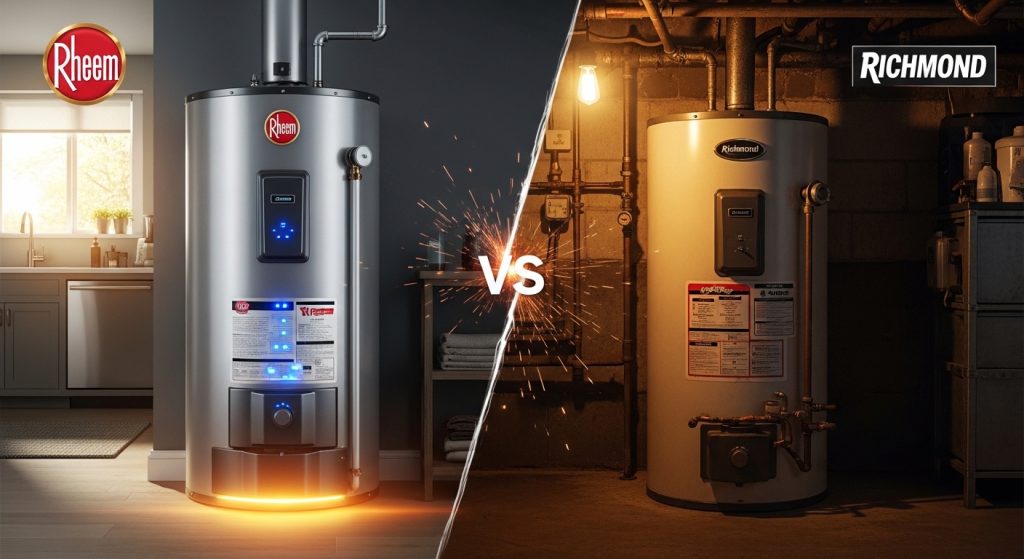
When choosing between Rheem and Richmond water heaters, you’ll find Richmond offers affordable, reliable tank and electric models with solid efficiency and flexible installation.
Rheem targets buyers wanting advanced tech, like Wi-Fi controls, leak detection, and premium materials for longer lifespan and higher energy savings, especially in tankless and hybrid units.
Richmond suits budget-conscious users, while Rheem appeals if you want smart features and longer warranties. Exploring their specs and features further will help clarify the best fit for your needs.
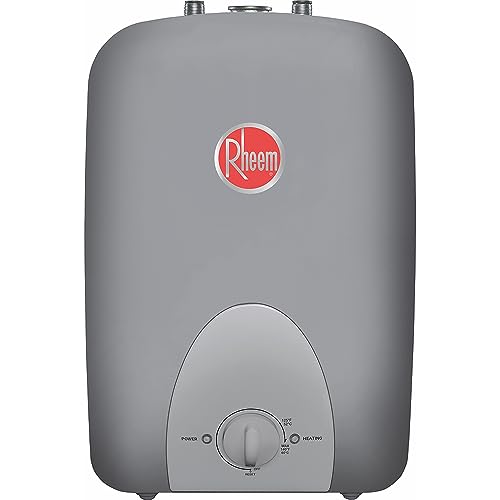
- 2.5-gallons of efficient hot water where you need it
- Easy to install point-of-use hot water
- Adjustable temperature control 50°-140°F

- It Works Effectively And Is Definitely A Great Quality Product.
- Space Saving Design
- For Installation In Tight Spaces
Key Takeaways
- Richmond offers affordable, reliable water heaters with basic features and flexible installation, focusing on cost-effective performance for gas and electric models.
- Rheem provides premium water heaters with advanced technology like Wi-Fi connectivity, leak detection, and automated energy management.
- Richmond water heaters generally have lower upfront costs and standard warranties, while Rheem models may offer longer warranties and enhanced durability.
- Rheem’s energy-efficient models, including hybrids and condensing tankless units, deliver higher savings but require higher initial investment than Richmond units.
- Richmond suits users seeking straightforward, dependable units, whereas Rheem targets customers desiring smart features and maximum energy efficiency.
Rheem vs Richmond Water Heater: Comparison Table
| Feature | Rheem Water Heater | Richmond Water Heater |
|---|---|---|
| Price Range | Higher upfront cost | More budget-friendly |
| Technology | Wi-Fi, app control, leak detection | Basic, reliable functionality |
| Energy Efficiency | Advanced hybrid & tankless models | Up to 95% efficiency (electric) |
| Warranty | Often longer warranties on select models | Limited tank & parts warranty |
| Tankless Options | Premium tankless with smart control | Standard tankless & gas models |
| Build Quality | Premium materials & innovation-driven | Durable, cost-effective construction |
| Best For | Tech-focused & long-term savings | Budget-conscious homeowners |
How Rheem and Richmond Water Heaters Compare in Price and Value?

When considering price and value, you’ll find that Richmond water heaters prioritize affordability without sacrificing essential performance. They’re an excellent choice for budget-conscious homeowners.
Richmond models offer reasonable upfront costs while maintaining dependable functionality across gas and electric options. You’ll notice Richmond balances price and utility effectively, providing solid recovery rates and energy efficiency that deliver long-term savings of up to $1,100 on condensing tankless units over 12 years.
In contrast, Rheem water heaters require higher initial investments, reflecting their focus on premium innovation and advanced technology. Rheem’s models often incorporate energy-efficient features that can translate to reduced operating costs.
Ultimately, if your priority is cost-effectiveness coupled with reliable performance, Richmond offers exceptional value without the premium price tag typical of Rheem units.
Additionally, Rheem’s use of flow valve technology enhances efficiency by supporting low-demand hot water and reducing energy waste.
Understanding Water Heater Types: Tank, Tankless, Gas, and Electric Options
When you’re deciding between tank and tankless water heaters, it’s important to consider both your hot water needs and the space you have available. For instance, if you have a large family that uses a lot of hot water at once, a tank model might be the way to go. On the other hand, if you’re short on space or prefer an on-demand option, a tankless heater could be your best bet.
Now, let’s talk about fuel types. Gas models usually have quicker recovery rates, which means you’ll get hot water faster when you need it. But if you’re looking for something that runs quietly and is easier to install, electric water heaters might be more up your alley.
Both Rheem and Richmond are solid choices in this market, offering reliable performance across different types of water heaters. So, getting to know their features and differences can really help you find the best fit for your home. Happy shopping!
Additionally, some tankless models feature self-modulating technology that adjusts energy use precisely to your hot water demand, enhancing efficiency and comfort.
Tank Versus Tankless
Explore the fundamental differences between tank and tankless water heaters to determine which system aligns with your household’s needs. Tank models store hot water in a reservoir, while tankless units heat water on demand, offering continuous flow.
- Capacity: Tanks hold a fixed volume. Tankless provides unlimited hot water but has a limited flow rate.
- Energy Use: Tanks consume energy to maintain temperature. Tankless activates only when needed, improving efficiency.
- Space: Tanks require more installation space. Tankless units are compact and wall-mounted.
- Cost & Maintenance: Tanks have lower upfront costs but higher energy bills. Tankless costs more initially but saves long-term with less heat loss and a longer lifespan.
Selecting between them depends on your household size, usage patterns, and budget priorities. Additionally, features like advanced corrosion resistance can significantly impact water heater longevity and performance.
Gas Water Heaters
Gas water heaters deliver hot water by burning natural gas or propane, offering rapid heating and cost-effective operation compared to electric models.
When choosing between Rheem and Richmond gas water heaters, consider that Richmond targets affordability without compromising reliability. They often use rebadged Rheem units with extended warranties.
Richmond’s gas models provide solid performance with universal side and top water connections for flexible installation. Rheem, on the other hand, integrates advanced technology like Wi-Fi connectivity and leak detection in its premium gas water heaters.
This enhances user control and safety. Both brands offer tank and tankless gas options with temperature and pressure relief valves for protection.
Richmond suits budget-conscious users needing dependable heat, while Rheem appeals to those prioritizing efficiency and smart features for long-term savings. Rheem also offers a broader product range including electric tanks and tankless options, giving consumers more variety to choose from.
Electric Water Options
Electric water heaters deliver reliable hot water by using electrical energy to heat water stored in tanks or on demand through tankless systems.
When choosing between Rheem and Richmond electric options, consider these factors:
- Type: Richmond offers tank models with a 21 gph recovery rate and copper heating elements. Rheem provides advanced tankless units for continuous hot water.
- Efficiency: Richmond electric models reach up to 95% energy efficiency. Rheem’s Protera hybrids excel further with superior energy savings.
- Features: Rheem integrates Wi-Fi, leak detection, and app control. Richmond focuses on robust, straightforward designs.
Additionally, Rheem’s electric units include self-modulating power control to optimize energy use and extend unit lifespan.
Understanding these points helps you balance upfront costs, technology, and long-term efficiency in your electric water heater choice.
Rheem vs Richmond Energy Efficiency and Savings
While both Rheem and Richmond deliver reliable hot water solutions, their approaches to energy efficiency and savings differ markedly.
Richmond’s Essential Series offers a solid 0.93 Uniform Energy Factor, with electric models achieving up to 95% efficiency. It balances upfront affordability with decent operational savings, potentially saving you around $1,100 over 12 years on condensing tankless models.
Rheem, on the other hand, focuses on advanced high-efficiency technology, exemplified by its ProTerra hybrid models, which provide superior energy performance and long-term cost reductions.
If you prioritize upfront cost savings, Richmond is practical. But if maximizing energy efficiency and reducing utility bills over time is your goal, Rheem’s premium models deliver greater value through innovative design and enhanced energy conservation. Hybrid water heaters like Rheem’s utilize heat pump technology to achieve higher UEF ratings and extended lifespan.
What Makes Rheem and Richmond Water Heaters Different: Key Features Compared?

Because both Rheem and Richmond cater to distinct user needs, their water heaters incorporate features that reflect their brand priorities.
When comparing key features, consider these points:
- Rheem integrates advanced technology such as Wi-Fi connectivity, app control, and leak detection, enhancing user interaction and maintenance.
- Richmond focuses on fundamental reliability, offering universal side/top water connections in models like the Encore for installation flexibility.
- Rheem’s Prestige series supports remote monitoring, allowing you to track performance and adjust settings seamlessly.
- Both brands include essential safety components, like temperature and pressure relief valves, ensuring operational safety.
Choosing Rheem means opting for innovation-driven features. Richmond provides straightforward functionality with dependable construction, catering to budget-conscious users without sacrificing quality.
Additionally, Rheem’s models often feature higher energy efficiency with UEF ratings up to 0.93, which can lead to significant long-term savings.
Build Quality Comparison
Beyond warranty terms, understanding the build quality of Rheem and Richmond water heaters helps you gauge their long-term durability and performance.
Richmond models feature strong, dependable construction designed for budget-conscious buyers without sacrificing reliability.
Their tanks use robust materials and proven manufacturing processes to guarantee consistent performance under high residential demand.
Rheem, as the parent brand, incorporates advanced technology and premium components, often resulting in enhanced durability and innovative features like leak detection and Wi-Fi connectivity.
While Richmond offers solid build quality suited for standard applications, Rheem’s units typically deliver superior longevity through cutting-edge design and materials.
Choosing between them depends on whether you prioritize affordability with reliable construction or premium durability paired with advanced innovation.
Both brands maintain high standards and guarantee dependable water heating performance in your home.
Additionally, selecting equipment with durable, chemical-resistant materials ensures extended lifespan and reliable operation under demanding conditions.
Rheem & Richmond Performance Specs: Recovery Rate & Capacity

Comparing Rheem and Richmond performance specs reveals key differences in recovery rate and capacity that directly impact your hot water availability.
Richmond’s 50-gallon electric tank heats 21 gallons per hour (GPH) at a 90°F rise, with a first-hour rating of 63 gallons, ensuring steady supply for typical household demand.
Rheem’s tankless models, however, provide continuous hot water on demand, eliminating storage limits.
Key points to contemplate:
- Richmond 50-gallon tank: 21 GPH recovery rate, 63-gallon first-hour rating
- Richmond electric elements: 4500W, copper heating for efficient heating
- Rheem tankless: infinite recovery, ideal for high-demand or variable use
- Richmond tank dimensions: compact 20-3/8″ diameter by 58-5/8″ height for space efficiency
Your choice hinges on whether you prefer consistent batch heating or endless flow.
Why Rheem Leads in Smart Water Heater Technology?
How does Rheem set itself apart in smart water heater technology? Rheem integrates advanced features like Wi-Fi connectivity, app control, and leak detection, enabling you to monitor and manage your water heater remotely.
Its Prestige series offers real-time diagnostics and energy usage tracking, optimizing performance and reducing costs. Richmond models focus on solid, reliable basics without smart controls.
| Feature | Rheem Smart Water Heaters | Richmond Water Heaters |
|---|---|---|
| Connectivity | Wi-Fi enabled, app control | No smart connectivity |
| Leak Detection | Integrated sensors | Not available |
| Remote Monitoring | Real-time diagnostics | Basic manual operation |
| Energy Management | Automated optimization | Standard efficiency controls |
Rheem’s technology enhances convenience and efficiency, giving you superior control over your water heating system.
Why Richmond Appeals to Budget-Conscious Homeowners?
Many budget-conscious homeowners choose Richmond water heaters because they deliver solid performance without a high upfront cost.
If you want reliability and efficiency without breaking the bank, Richmond offers a smart balance.
Consider these key reasons:
1. Affordable Pricing: Richmond models come at reasonable prices, making initial investment manageable.
2. Energy Efficiency: Their Essential Series boasts a 0.93 Uniform Energy Factor, helping you save on utility bills.
3. Durability: With dependable construction, Richmond guarantees long-term value.
4. Simple Installation: Universal side/top water connections reduce installation complexity and costs.
Decision Guide: Choosing Between Rheem and Richmond Water Heaters
Choosing between Rheem and Richmond water heaters comes down to evaluating your priorities in technology, budget, and energy efficiency.
If you want advanced features like Wi-Fi connectivity, remote monitoring, and superior energy-saving hybrid models, Rheem is the clear choice, though it demands a higher upfront investment.
Conversely, Richmond offers reliable, budget-friendly units with solid performance, such as the Essential Series with a 0.93 UEF and universal water connections, ideal for cost-conscious buyers.
Consider the warranty too: Richmond provides long limited tank and parts coverage, while Rheem may offer longer warranties on select models.
Both brands support gas, electric, and tankless types. Assess your long-term energy savings against initial costs and desired functionalities to make an informed decision tailored to your household needs.
Frequently Asked Questions
Are Rheem and Richmond Water Heaters Easy to Install for DIY Homeowners?
You’ll find both Rheem and Richmond water heaters relatively straightforward to install if you have plumbing and electrical experience.
Richmond models offer simpler configurations, making them more DIY-friendly.
Rheem’s advanced units, especially those with smart features or tankless designs, might require more technical knowledge and careful handling.
Always follow manufacturer instructions closely, guarantee proper safety measures, and consider local codes.
When in doubt, consulting a professional can save time and avoid costly mistakes.
How Do Rheem and Richmond Water Heaters Perform in Cold Climates?
In cold climates, both brands perform reliably.
Rheem’s tankless models excel with continuous hot water and advanced insulation, minimizing heat loss.
Richmond’s 50-gal electric heaters offer solid recovery rates (21 gph at 90°F rise), handling cold water efficiently.
If you’re managing freezing temperatures, Rheem’s high-efficiency and hybrid models provide superior energy savings.
Richmond delivers dependable, budget-friendly warmth with strong construction and effective insulation.
What Maintenance Is Recommended for Rheem and Richmond Water Heaters?
You should flush your water heater annually to remove sediment buildup, improving efficiency and lifespan.
Check the anode rod every 2-3 years and replace it if corroded to prevent tank damage.
Inspect temperature and pressure relief valves yearly for proper operation.
For Rheem models with Wi-Fi, monitor diagnostics via the app.
Always turn off power and water supply before maintenance.
Regularly maintaining guarantees reliable performance and longevity.
Can Richmond Water Heaters Be Upgraded With Smart Features Later?
Like adding a smart chip to a classic watch, upgrading Richmond water heaters with smart features later isn’t straightforward.
Richmond models generally lack built-in Wi-Fi or app connectivity, so retrofitting smart controls requires external devices or smart thermostats compatible with your unit.
You’ll need to verify compatibility and professional installation for proper integration.
If smart tech is a must, consider models designed with those features from the start.
Do Rheem and Richmond Water Heaters Require Specific Water Pressure Levels?
Yes, both Rheem and Richmond water heaters require specific water pressure levels for optimal operation.
Typically, they function best within 40 to 80 psi.
If your home’s water pressure exceeds this range, installing a pressure-reducing valve is essential to prevent damage.
Conversely, low pressure below 40 psi may reduce performance and hot water delivery.
Always check your model’s manual for exact pressure specifications to guarantee safety and efficiency.
Choosing Between Rheem and Richmond with Confidence
Choosing between Rheem and Richmond water heaters is like picking the right engine for your car. Both get you there, but with different strengths. Rheem’s smart tech and efficiency are like a turbocharged motor, delivering faster recovery and energy savings.
Richmond, with its budget-friendly pricing, acts as a reliable workhorse. Know your priorities: cutting-edge features or cost-conscious reliability. This clarity will steer you to the perfect water heater for your home’s needs.
- 2.5-gallons of efficient hot water where you need it
- Easy to install point-of-use hot water
- Adjustable temperature control 50°-140°F
- It Works Effectively And Is Definitely A Great Quality Product.
- Space Saving Design
- For Installation In Tight Spaces
Last update on 2026-03-31 / Affiliate links / Images from Amazon Product Advertising API