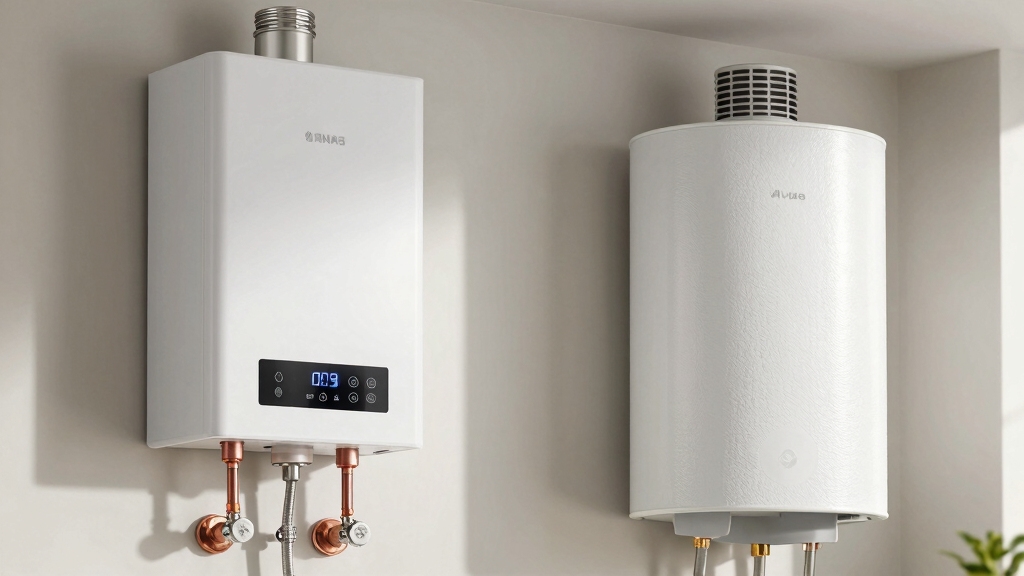
You’ll find hybrid water heaters use a heat pump and tank storage for efficient, steady hot water ideal in moderate climates. Tankless heaters provide on-demand heat without storage, saving space and offering endless hot water.
Hybrid units are more energy-efficient but bulkier. Tankless systems require complex installation, especially for gas models. Each excels in different settings, and the choice depends on your household size, budget, and climate.
Explore their performance, costs, and maintenance to decide what fits your home best.
Key Takeaways
- Hybrid water heaters use heat pumps with storage tanks, offering steady hot water and higher efficiency but with some standby heat loss.
- Tankless heaters provide on-demand hot water with no standby loss, are compact, and maintain performance regardless of ambient temperature.
- Hybrid units save up to 60% energy versus conventional tanks; tankless models save 30–40% mainly by eliminating standby losses.
- Tankless systems often require complex venting and gas line upgrades; hybrids run on electricity with simpler installation and qualify for higher rebates.
- Hybrid water heaters typically last 10–15 years needing filter and heat pump maintenance; tankless units have longer lifespans but need regular descaling.
Comparison Table for Hybrid & Tankless Water Heater
| Feature | Hybrid Water Heater | Tankless Water Heater |
|---|---|---|
| How It Works | Uses heat pump to extract ambient air heat and stores hot water in a tank | Heats water on demand using flow-through heating, no storage tank |
| Hot Water Supply | Steady supply from stored tank; great for peak demand | Endless hot water, but may struggle with multiple fixtures at once |
| Energy Efficiency | 2–3x more efficient than electric resistance; saves up to 60% | Saves 30–40% by eliminating standby losses |
| Standby Heat Loss | Yes (due to tank storage) | None |
| Performance in Large Households | Excellent for simultaneous multi-fixture use | May experience flow or temperature drops under heavy demand |
| Climate Suitability | Best in moderate to warm climates | Performs consistently in all climates |
| Upfront Cost | Moderate to high; rebate eligible | High; complex installation increases cost |
| Installation Complexity | Electric-powered; simpler installation | Requires venting, gas line upgrades (for gas models) |
| Space Requirements | Larger footprint due to tank | Compact, space-saving design |
| Lifespan | 10–15 years | 15–20 years |
| Maintenance Needs | Filter cleaning and heat pump maintenance | Regular descaling and flushing required |
| Long-Term Savings | Significant electricity bill reduction | Moderate energy cost reduction |
| Rebates & Incentives | Often higher due to greater efficiency | Available but typically lower than hybrid |
| Noise Level | Moderate (similar to refrigerator hum) | Generally quieter; minimal operational noise |
| Solar Compatibility | Fully compatible (electric-based) | Electric models compatible; gas models less so |
How Hybrid and Tankless Water Heaters Work?

Understanding how hybrid and tankless water heaters work helps you choose the right system for your needs.
Knowing how hybrid and tankless water heaters function guides you to the best choice for your home.
A hybrid water heater operates like a reverse refrigerator, using a heat pump to extract ambient heat from the air and transfer it to water stored in a tank. This process is highly efficient, as it moves heat rather than generating it.
In contrast, a tankless water heater heats water on demand through a flow-through system without storing it, providing endless hot water instantly.
There’s also a hybrid tankless variant that combines a small storage tank for temperature modulation and self-cleaning features, reducing maintenance.
Each system’s operational principle directly impacts installation requirements, performance, and suitability depending on your household’s hot water demand and space constraints.
Installation complexity and costs can vary significantly depending on factors such as the unit size and desired installation location.
Comparing Energy Efficiency of Hybrid and Tankless Water Heaters
When comparing energy efficiency, hybrid water heaters consistently outperform tankless models by a significant margin. Hybrid units use heat pump technology, achieving efficiencies 2-3 times greater than electric resistance. They save up to 60% energy versus conventional tanks.
Tankless heaters save 30-40%, mainly by eliminating standby losses but lack the superior heat extraction of hybrids.
| Feature | Hybrid Water Heater | Tankless Water Heater |
|---|---|---|
| Energy Savings | Up to 60% over tanks | 30-40% over tanks |
| Efficiency Mechanism | Heat pump extracts ambient heat | Flow-through heating on demand |
| Standby Energy Loss | Present due to tank storage | None |
Choosing hybrid means greater electricity savings, especially in varied climates. Proper ventilation requirements are essential to maintain the efficiency and safety of hybrid water heaters.
Performance of Hybrid and Tankless Water Heaters for Large Households

When you’re managing hot water for a large household, it’s super important to have a consistent supply and reliable performance across multiple fixtures, right?
So, let’s talk about hybrid water heaters for a moment. They store heated water in a tank, which means you can count on having a steady availability even when you have multiple demands going on at the same time. That’s pretty handy!
Now, on the flip side, we’ve tankless units. These bad boys offer endless hot water, which sounds great, but here’s the catch: they can sometimes struggle to keep the flow steady when several fixtures are running at once.
So, if you’ve got a big family and everyone’s taking showers or running the dishwasher at the same time, you might run into some issues there. It’s always good to weigh the pros and cons, don’t you think? Hybrid water heaters also provide quiet operation and energy efficiency, making them a reliable choice for family homes.
Hot Water Supply Consistency
Although both hybrid and tankless water heaters offer energy-efficient solutions, their performance in delivering consistent hot water varies markedly, especially in large households.
Hybrid water heaters store a reservoir of heated water, ensuring steady availability during peak demand. This storage capability mitigates temperature fluctuations, providing reliable hot water even when multiple fixtures operate simultaneously.
Conversely, tankless systems heat water on demand, which can strain their capacity under high simultaneous usage, potentially causing temperature drops or flow limitations. While tankless units excel in continuous flow, their instant heating mechanism may struggle to maintain consistent temperatures in large homes without supplementary units.
Consequently, if you prioritize steady hot water supply under heavy load, hybrids generally outperform tankless options, delivering superior consistency through their stored hot water buffer. Additionally, hybrid models often incorporate temperature/pressure relief valves to enhance safety during high-demand situations.
Multiple Fixture Performance
Since large households often use multiple water fixtures simultaneously, understanding how hybrid and tankless water heaters handle such demand is essential.
Hybrid water heaters excel here by storing heated water in a tank, enabling consistent delivery across several outlets without pressure drops. Conversely, tankless models heat water on demand, which can limit simultaneous output when multiple fixtures run, potentially causing temperature fluctuations or reduced flow.
Consider these performance aspects for large households:
- Hybrid supports multiple bathrooms and appliances simultaneously with steady hot water.
- Tankless may struggle to maintain flow rate when several fixtures operate at once.
- Hybrid tankless variants improve modulation, reducing cold water bursts.
- Tankless efficiency shines with single or sequential fixture use but can falter under heavy simultaneous demand.
Choosing the right system depends on your household’s fixture usage patterns and flow requirements.
Additionally, some hybrid models incorporate heat pump technology to enhance energy efficiency while maintaining performance under heavy loads.
Upfront and Long-Term Costs of Hybrid vs Tankless Water Heaters
Understanding the upfront and long-term costs of hybrid and tankless water heaters helps you make an informed investment.
Hybrid units generally cost twice as much as conventional tanks but align closely with tankless prices.
Tankless systems demand higher initial expenses due to installation complexities like venting and gas line upgrades.
However, hybrids often qualify for greater rebates and tax credits.
Both types offset upfront costs through significant energy savings, with hybrids reducing electricity bills more effectively across climates.
Heat pump water heaters, similar to hybrids, offer energy efficiency advantages that make them suitable for various temperature conditions.
| Cost Aspect | Hybrid Water Heater | Tankless Water Heater |
|---|---|---|
| Upfront Cost | Moderate to high, rebate eligible | High, complex installation |
| Installation | Electric, simpler | Requires venting, gas line upgrade |
| Energy Savings | Up to 60%, better in various climates | 30-40%, no standby loss |
| Long-term Savings | Significant electricity bill reduction | Moderate energy cost reduction |
Lifespan and Maintenance Needs for Hybrid and Tankless Water Heaters
When choosing between hybrid and tankless water heaters, you should consider their lifespan and maintenance requirements, as these directly affect long-term reliability and cost.
Hybrid water heaters typically last 10-15 years and need regular filter changes and heat pump upkeep to maintain efficiency.
Tankless units boast a longer lifespan, around 15-20 years, but require periodic descaling and flushing to prevent mineral buildup.
Proper maintenance for both extends their operational life well beyond conventional tanks.
Key maintenance points include:
Hybrid demands filter cleaning and heat pump inspection.
Tankless requires professional flushing to remove scale.
Hybrid tankless models feature self-cleaning to reduce upkeep.
Both systems benefit from scheduled servicing for peak performance.
Understanding these factors helps you select the right system for your household needs.
Additionally, if considering an outdoor installation, ensuring proper ventilation and protection is crucial to maintain unit efficiency and longevity.
Hybrid Tankless Water Heaters: Blending the Best of Both Types
Hybrid tankless water heaters really blend the best of both worlds, don’t you think?
They’re all about high efficiency and lower maintenance, thanks to some nifty self-cleaning features. This means you get to enjoy consistent performance without the hassle of constant upkeep.
And here’s something you’ll love — these heaters modulate heat with a small storage tank. This clever design helps to prevent those annoying cold water bursts.
Plus, if you’re tight on space, you’ll appreciate their compact design. They save room compared to traditional hybrids while still outperforming standard tankless models. Pretty impressive, right?
Many models also incorporate self-modulating technology to precisely adjust energy use and maintain temperature within 1 degree for optimal comfort and efficiency.
Hybrid Tankless Efficiency
Hybrid tankless water heaters combine the energy-saving advantages of heat pump technology with the on-demand heating of tankless systems. They achieve up to 15% greater efficiency than standard tankless models and around 40% compared to conventional storage tanks.
You benefit from a system that extracts ambient heat efficiently while providing hot water instantly. This reduces energy consumption notably and minimizes losses typical in traditional storage systems. It also improves modulation with a small tank to stabilize flow and temperature.
- Uses heat pump to triple efficiency over electric resistance heating
- Eliminates standby heat loss common in standard tanks
- Offers precise temperature control with on-demand heating
- Self-cleaning mechanism reduces scaling and maintains peak performance
This design guarantees sustained energy savings and reliable hot water delivery. Additionally, many hybrid tankless models incorporate recirculation pumps to enhance hot water delivery speed and overall efficiency.
Maintenance Advantages
Frequently, maintaining water heaters can be a complex and time-consuming task.
However, hybrid tankless models simplify this process by integrating self-cleaning features that reduce scale buildup and minimize routine upkeep.
Unlike traditional tankless units, which require regular professional descaling and flushing to prevent mineral deposits, hybrid tankless heaters use automated mechanisms to manage scale accumulation.
This reduces the frequency of manual maintenance and extends system longevity.
Additionally, hybrid units combine heat pump technology with a small modulation tank, requiring less frequent filter changes and heat pump care compared to standalone hybrids.
By blending these technologies, you benefit from lower maintenance demands without sacrificing performance or durability.
This makes hybrid tankless water heaters a practical choice for reducing long-term service needs and operational interruptions.
Moreover, some advanced models incorporate field replaceable heating elements, enhancing ease of maintenance and component replacement.
Performance And Space
How can a water heater deliver both consistent hot water and save valuable space?
Hybrid tankless water heaters blend the strengths of hybrid and tankless systems, offering steady hot water with a smaller footprint. Unlike traditional hybrids, they include a compact tank for modulation, preventing cold water sandwiches and maintaining flow.
This design optimizes performance while reducing space requirements.
- Provides steady hot water supply with minimal wait time
- Compact tank allows modulation, ensuring consistent temperature
- Smaller than standard hybrids, yet avoids tankless flow issues
- Self-cleaning feature reduces maintenance, enhancing reliability
You get efficient, reliable hot water without sacrificing room, making hybrid tankless heaters ideal for varied household demands.
Choosing the Best Water Heater Based on Your Climate
When selecting a water heater, your local climate plays a crucial role in determining which system performs most efficiently and reliably.
Hybrid water heaters rely on extracting heat from ambient air, so they excel in moderate to warm climates where they can operate at peak efficiency.
In colder regions, their performance drops as the heat pump must work harder, potentially increasing energy consumption.
Tankless water heaters, independent of ambient air temperature, maintain consistent performance regardless of climate, making them ideal for colder areas.
However, in extremely cold water supply conditions, tankless units may require additional energy to reach desired temperatures.
Assess your region’s average temperature and heating demands to choose a system that balances energy efficiency and reliable hot water delivery throughout the year.
Installation and Space Needs for Hybrid and Tankless Water Heaters
Selecting the right water heater based on climate naturally leads to taking into account installation and space requirements, as these factors affect your home’s layout and utility connections.
Hybrid water heaters need ample room for their storage tanks and heat pump units, while tankless models boast compact, backpack-sized designs that save space.
However, tankless heaters may require upgrades like larger gas lines, venting systems, or electrical circuits. Both demand professional installation, with tankless often costing more due to complexity.
Consider these points for installation and space:
- Hybrid units occupy more floor or wall space due to tank size.
- Tankless heaters fit tight spaces, ideal for small utility areas.
- Tankless installation might involve venting and fuel line upgrades.
- Hybrid runs on electricity, avoiding combustion venting needs.
Rebates and Incentives for Hybrid and Tankless Water Heaters
Frequently, you can markedly reduce the upfront cost of both hybrid and tankless water heaters through available rebates and tax incentives.
Hybrid units often qualify for higher rebates due to their superior energy efficiency, saving up to 60% compared to conventional models.
These incentives may come from federal, state, or utility programs and can materially offset initial expenses.
Tankless water heaters, while eligible for incentives, typically receive lower rebates reflecting their 30-40% energy savings.
To maximize benefits, verify eligibility criteria, including energy factor ratings and installation requirements.
Applying for these programs requires documentation of purchase and installation.
Frequently Asked Questions
Can Hybrid and Tankless Water Heaters Be Installed Outdoors?
You can install certain tankless water heaters outdoors since many models are designed with weatherproof casings and freeze protection.
However, most hybrid water heaters require indoor installation because their heat pump components are sensitive to cold temperatures and moisture exposure.
If you want a hybrid outdoors, make certain it’s a model rated for outdoor use with adequate shelter and climate control.
Always follow manufacturer guidelines and local codes to guarantee safe, efficient operation.
How Do Hybrid and Tankless Heaters Impact Home Resale Value?
Installing a hybrid or tankless water heater is like planting a future-proof tree in your home’s foundation.
You’ll boost resale value by appealing to energy-conscious buyers who appreciate long-term savings and modern efficiency.
Hybrid units symbolize sustainability with their high energy savings, while tankless models represent cutting-edge innovation and endless hot water.
Both signal well-maintained systems, increasing your home’s market competitiveness and desirability in today’s eco-aware real estate market.
Are Hybrid or Tankless Water Heaters Compatible With Solar Power Systems?
Yes, both hybrid and tankless water heaters are compatible with solar power systems.
You can power either type using solar-generated electricity, enhancing energy savings and reducing your carbon footprint.
Hybrid models, relying solely on electricity, integrate smoothly with solar setups.
Tankless units, especially electric versions, also work well, though gas-powered tankless heaters won’t benefit directly.
Make sure your solar system’s capacity matches the water heater’s power demands for peak performance.
What Noise Levels Can Be Expected From Hybrid Vs Tankless Units?
You can expect hybrid water heaters to produce moderate noise, similar to a refrigerator’s hum, due to the heat pump operation.
Tankless units run quieter since they heat water on demand without a compressor but may emit low-level sounds from the flow sensor or gas burner.
If noise sensitivity matters, hybrids create consistent background noise, while tankless models remain mostly silent except during active heating cycles.
Do Hybrid or Tankless Water Heaters Require Special Water Pressure Settings?
You don’t usually need special water pressure settings for hybrid or tankless water heaters, but both have ideal pressure ranges.
Hybrid units typically operate well between 40-80 psi.
Tankless models require steady pressure, often 30-80 psi, to maintain consistent flow rates and avoid triggering error codes.
If your home’s pressure is too low or high, you might need a pressure regulator or booster to guarantee efficient, reliable operation and protect the heater’s components.
Efficiency Meets Comfort: Your Best Water Heater Pick
Choosing between hybrid and tankless water heaters is like selecting the right tool for a complex job. Each excels under different conditions.
Hybrid models offer balanced energy efficiency and capacity, ideal for larger households. Tankless units provide on-demand heating with minimal space use.
Consider your household size, climate, and budget to make an informed decision. With proper installation and maintenance, either option can deliver reliable, efficient hot water tailored to your needs.